

Local SEO for Franchises: Win Every Market | Franchise Solutions 360
Blucorp is now available worldwide. Create Your Account today.
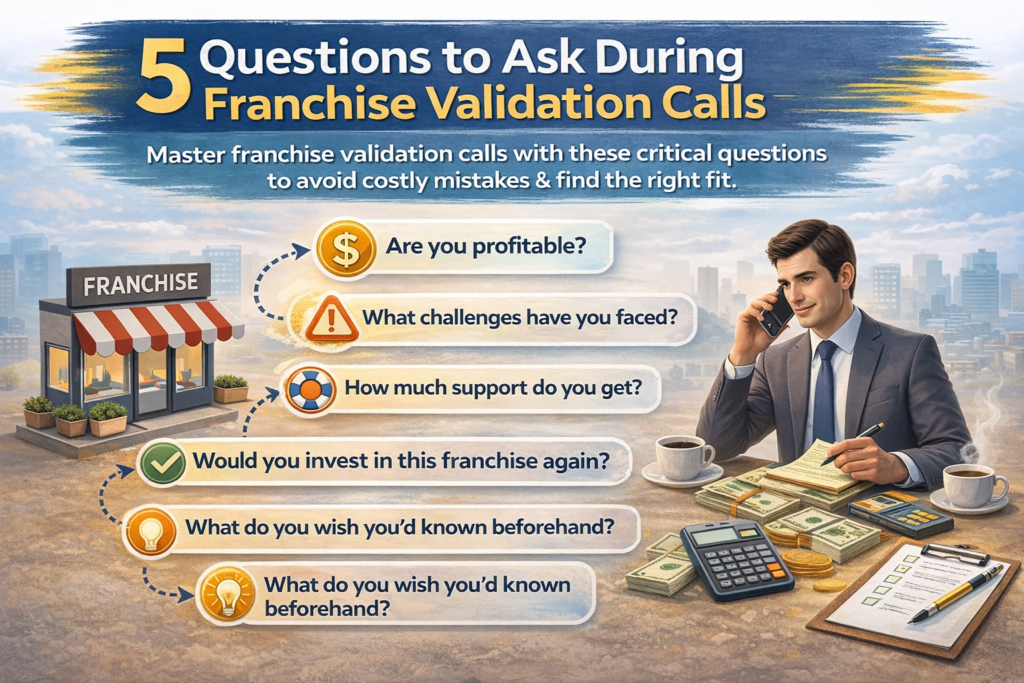
5 Questions to Ask During Franchise Validation Calls
5 Questions Every First-Time Franchisee Should Ask During Validation Calls
Validation calls are your direct line to the truth. Before you invest six or seven figures into a franchise, you have the unique opportunity to speak with people who’ve already made the leap—current franchisees operating under the same brand, facing the same challenges, and living the reality behind the marketing materials.
Yet most first-time buyers approach franchise validation calls without a strategic framework. They ask surface-level questions, accept rehearsed answers, and walk away feeling reassured but no more informed than before. That’s a dangerous position when you’re about to commit significant capital and years of your life to a business model.
According to the International Franchise Association, over 775,000 franchise establishments operate in the United States alone, generating $827.5 billion in economic output. But not every franchise delivers on its promises. The difference between a profitable investment and a costly mistake often comes down to the quality of your validation process—and the questions you ask during those critical conversations with existing franchisees.
This guide reveals the five most important questions to ask during franchise validation calls, why they matter, and how to interpret the answers you receive. These aren’t generic questions you’ll find on a franchisor’s recommended list. These are the questions that reveal operational reality, financial truth, and cultural fit—the factors that determine whether you’ll thrive or struggle in your franchise investment.
Why Franchise Validation Calls Matter More Than You Think
The Franchise Disclosure Document (FDD) provides Item 20—a list of current and former franchisees. This isn’t just a regulatory formality. It’s your most valuable research tool. While the FDD shows you numbers, policies, and legal disclosures, franchise validation calls show you human experience.
Validation calls serve multiple purposes:
- Verify claims: Franchisors paint optimistic pictures. Franchisees tell you what it’s really like to operate the business day-to-day.
- Identify red flags: Patterns of dissatisfaction, broken promises, or operational challenges become visible when you speak with multiple franchisees.
- Assess support quality: You’ll learn whether the franchisor’s support promises translate into meaningful help when problems arise.
- Understand true costs: Hidden expenses, working capital needs, and realistic revenue timelines emerge through honest conversations.
- Evaluate cultural fit: You’ll discover whether the franchisee community aligns with your values, work style, and business philosophy.
The Small Business Administration reports that franchises have a higher survival rate than independent startups—but that advantage only materializes when you choose the right franchise for your situation. Validation calls are where informed decisions are made or missed.
How to Approach Franchise Validation Calls Strategically
Before we dive into the specific questions, understand the validation call framework:
Call at least 10-15 franchisees to identify patterns rather than outliers. Include a mix of tenures—new franchisees (under 2 years), mid-term operators (2-5 years), and veterans (5+ years). This reveals how the franchise experience evolves over time.
Request franchisees similar to your profile. If you’re planning a semi-absentee model, speak with semi-absentee operators. If you’re in a specific territory type (urban vs. suburban vs. rural), talk to franchisees in comparable markets.
Schedule 20-30 minute conversations rather than quick 10-minute calls. Rushed conversations yield surface answers. Deeper discussions reveal operational reality.
Take detailed notes and look for consistency across multiple conversations. One disgruntled franchisee might be an outlier. Five franchisees expressing similar concerns indicate a systemic problem.
Now let’s examine the five critical questions that separate informed franchise validation calls from wasted opportunities.
Question 1: "If You Could Go Back to Day One, What Would You Do Differently—and What Would You Absolutely Do the Same?"
Why This Question Works
This question bypasses defensiveness and invites reflection. It doesn’t ask franchisees to criticize the franchisor or express regret. Instead, it positions them as mentors sharing hard-won wisdom.
The answers reveal several critical insights:
Operational mistakes you can avoid. Franchisees often share specific decisions that cost them time or money—hiring too quickly, skimping on working capital, choosing the wrong location within their territory, or underestimating marketing needs during launch.
What the franchisor gets right. When franchisees say what they’d “absolutely do the same,” you learn what aspects of the franchise system deliver real value—whether it’s training quality, vendor relationships, marketing support, or operational systems.
Realistic expectations for the learning curve. You’ll understand how long it actually takes to become profitable, master operations, or build a customer base—beyond what the franchisor’s projections suggest.
What to Listen For
Red flags: If multiple franchisees say they wish they’d read the FDD more carefully, questioned certain claims, or negotiated terms differently, pay attention. If they express regret about joining the system entirely, probe deeper to understand why.
Green flags: Consistent praise for specific support elements—like onboarding, ongoing training, or responsive field support—indicates the franchisor delivers on promises. Franchisees who say they’d “do it again in a heartbeat” despite challenges show resilient belief in the model.
Working capital warnings: If multiple franchisees mention they’d start with more cash reserves, adjust your financial planning accordingly. Franchisors often underestimate the working capital buffer needed during the critical first 12-18 months.
Question 2: "Walk Me Through Your Actual Monthly Expenses—Not Just What's in the FDD, but Real-World Operating Costs"
Why This Question Matters
The FDD Item 19 provides financial performance representations—if the franchisor chooses to disclose them. But even detailed Item 19 data represents averages, medians, or top-performer results. It doesn’t show your specific market reality or account for variables the franchisor can’t predict.
Real-world operating costs often exceed FDD projections for several reasons:
- Market-specific labor costs: Wage rates vary dramatically by geography. What works in Tennessee doesn’t match California’s minimum wage structure.
- Hidden operational expenses: Credit card processing fees, POS system subscriptions, insurance riders, local licensing fees, and ongoing marketing co-op contributions add up quickly.
- Seasonal variation: Many franchises experience revenue fluctuations while fixed costs remain constant, creating cash flow challenges during slow months.
- Staffing reality: Franchisors model skeleton crews. Actual operations often require more labor hours to maintain quality and customer service standards.
How to Ask This Question Effectively
Frame it as seeking mentorship rather than prying into private finances: “I want to budget realistically so I’m not caught off-guard. Can you walk me through your major expense categories and where actual costs surprised you compared to initial projections?”
Most franchisees will share percentage allocations or category ranges without disclosing exact dollar amounts: “Labor runs about 35% of revenue,” or “I spend about $3,000 monthly on local marketing beyond the required marketing fund contribution.”
What to Listen For
Cost categories franchisors minimize: Technology fees, equipment maintenance, local marketing requirements, and royalty calculations on gross vs. net revenue can significantly impact profitability.
Break-even timeline reality: If franchisees consistently report 18-24 months to break even when the franchisor projects 12 months, adjust your financial model and working capital needs accordingly.
Territory performance variation: Understanding which territories outperform or underperform helps you evaluate whether your specific market presents favorable conditions or challenges.
Question 3: "When You've Had Operational Problems or Needed Support, How Responsive and Helpful Has the Franchisor Been?"
Why This Question Is Critical
Every franchisor promises robust support. Few deliver consistent, meaningful help when franchisees face real operational challenges. The quality of ongoing support often determines the difference between franchisee success and failure.
Franchise validation calls reveal support reality through specific examples rather than marketing promises:
Response time matters. When a critical piece of equipment fails, a key employee quits unexpectedly, or a local competitor launches an aggressive campaign, do you get a response in hours or days? Does the franchisor provide actionable solutions or generic encouragement?
Support evolution reveals priorities. Some franchisors provide excellent support during the honeymoon period—the first 6-12 months when you’re learning the system. Then support quality degrades as they focus resources on new franchisee recruitment rather than existing franchisee success.
Field support accessibility matters. Is your assigned field consultant available, knowledgeable, and empowered to help? Or do franchisees describe field support as inexperienced, overwhelmed, or primarily focused on compliance enforcement rather than problem-solving partnership?
Follow-Up Questions to Ask
If a franchisee mentions a specific challenge they faced:
- “How quickly did you get a response from the franchisor?”
- “What specific support did they provide?”
- “Did the solution actually work, or did you have to figure it out yourself?”
- “Looking back, do you feel supported or on your own?”
What to Listen For
Red flags: Franchisees who describe franchisor support as “non-existent,” “unhelpful,” or “they only care about royalty checks” indicate serious problems. Multiple franchisees expressing frustration with support responsiveness or quality should immediately concern you.
Green flags: Specific examples of proactive franchisor intervention—”When COVID hit, they immediately created new marketing campaigns and helped us pivot to delivery,” or “My field consultant helped me redesign my staffing model to reduce labor costs by 8% while maintaining service quality.”
Peer support strength: In strong franchise systems, franchisees help each other through informal networks, Facebook groups, or regional associations. If franchisees describe a collaborative culture and active peer support network, that’s a significant asset regardless of formal franchisor support quality.
Question 4: "How Accurate Were the Franchisor's Revenue Projections Compared to Your Actual Performance—and What Factors Influenced the Difference?"
Why This Question Reveals Truth
Financial performance during franchise validation calls matters more than any other single factor for most investors. Yet this is also where franchisors and franchisees sometimes present conflicting narratives.
Franchisors typically present optimistic scenarios—best-case performance, high-performing locations, or carefully selected averages that exclude struggling units. They’re not lying, but they’re emphasizing success stories while minimizing challenges.
This question accomplishes several objectives:
Reality-checks projections. You’ll learn whether the franchisor’s revenue models reflect typical performance or best-case scenarios. A 20% variance might be reasonable market fluctuation. A 50% variance indicates the projections are marketing tools, not operational planning documents.
Identifies success factors. Franchisees who exceed projections can explain why—superior location selection, exceptional local marketing, operational excellence, or favorable market conditions. These insights help you evaluate whether you can replicate their success.
Reveals struggle factors. Franchisees underperforming projections often cite factors outside their control—oversaturated territory, inadequate franchisor marketing support, competitive pressures the franchisor underestimated, or flawed business model assumptions.
How to Ask This Sensitively
Financial questions can feel intrusive. Frame your inquiry around ranges and timing rather than exact numbers:
“I’m trying to build realistic financial models. Were you at the revenue levels the franchisor projected by month 12, ahead of schedule, or behind? If there was a variance, what do you think drove the difference?”
What to Listen For
Consistency across franchisees. If 12 out of 15 franchisees you interview report meeting or exceeding projections, the model likely works. If 8 out of 15 are significantly behind projections, reassess the opportunity regardless of what individual high performers report.
Market-specific variables. Some franchise models thrive in specific markets but struggle in others. Understanding which market characteristics predict success helps you evaluate your territory’s viability.
Time-to-profitability reality. If the franchisor claims 6-month break-even but franchisees consistently report 18 months, your working capital requirements triple. This dramatically changes the risk profile and investment return timeline.
Question 5: "If Someone You Cared About Was Considering This Franchise, What Would You Tell Them About the Lifestyle, Time Commitment, and Stress Level?"
Why This Question Is Uniquely Valuable
Franchise buyers often fixate on financial performance while underestimating lifestyle fit. Yet operational stress, time demands, and lifestyle disruption cause franchisee dissatisfaction as often as financial underperformance.
This question invites candid reflection because it asks franchisees to think about someone they care about—not a stranger, not a business transaction. The protective instinct this triggers often yields the most honest answers you’ll receive during franchise validation calls.
What This Question Reveals
True time commitment. Franchisors often present semi-absentee models or 40-hour work weeks. Franchisees reveal whether you’ll actually spend 60+ hours during the launch phase, whether weekends are consumed by operational demands, and how long it takes before the business can run without constant owner involvement.
Stress factors. Some franchise models create constant stress through thin margins, difficult employee management, complex operations, or demanding customers. Other models offer relatively calm operations once systems are established. Understanding stress reality before investment prevents lifestyle regret.
Family impact. Franchisees often share how franchise ownership affected their family life, whether their spouse became an unpaid employee out of necessity, how their children adjusted to parental availability changes, and whether work-life balance improved or deteriorated compared to their previous career.
Exit considerations. This question sometimes reveals franchisees considering exit—they might not volunteer this information otherwise, but the personal framing encourages honesty about whether they’d recommend someone they care about make the same decision they made.
What to Listen For
Red flags: Franchisees who say “I’d never recommend this to someone I care about” or describe the lifestyle as “all-consuming,” “relentlessly stressful,” or “not worth it financially” should immediately concern you—even if their business is technically profitable.
Green flags: Franchisees who enthusiastically say “I’d recommend it in a heartbeat” or describe improved lifestyle, flexibility, and fulfillment indicate strong model-operator fit. Even franchisees who acknowledge challenges but remain committed signal the lifestyle trade-offs are worthwhile.
Realistic expectations: The best franchisees provide balanced perspectives: “The first year was brutal—80-hour weeks and constant problem-solving. But by year two, I had systems in place, good staff, and I’m working 45 hours with better income than my corporate job. I’d tell them to expect a tough 12-18 months before it gets better.”
How to Synthesize Validation Call Insights
After completing 10-15 franchise validation calls, take time to synthesize what you’ve learned:
Create a tracking spreadsheet with columns for each question and rows for each franchisee. Look for patterns, outliers, and consistency across multiple conversations.
Categorize feedback:
- Unanimous concerns = investigate immediately or walk away
- Majority patterns = adjust expectations and planning accordingly
- Individual outliers = note but don’t overweight
- Consistent praise = genuine system strengths
Compare validation feedback against FDD claims and franchisor promises. Where do they align? Where do they diverge? Material discrepancies deserve frank conversations with the franchisor before proceeding.
Reassess your personal fit based on lifestyle reality, time commitment clarity, and stress level understanding. Financial performance matters, but only if you can sustain the operational demands without sacrificing your wellbeing or family relationships.
Beyond These Five Questions: Building Your Complete Validation Strategy
While these five questions form the core of effective franchise validation calls, a comprehensive due diligence process includes additional research layers:
- Former franchisee interviews: Item 20 lists departed franchisees. Contact them to understand why they left—franchise failures, voluntary exits, or franchise system problems.
- Legal review: Have a franchise attorney review your FDD, franchise agreement, and any territory agreements to identify unfavorable terms or risks.
- Financial modeling: Build conservative financial projections based on validation call insights, not franchisor optimism. Include stress tests for revenue shortfalls and expense overruns.
- Market analysis: Evaluate your specific territory’s demographics, competition, and market saturation independent of franchisor claims.
- Personal readiness assessment: Honestly evaluate whether you have the skills, capital buffer, risk tolerance, and lifestyle flexibility franchise ownership demands.
Common Mistakes to Avoid During Franchise Validation Calls
Calling only franchisees the franchisor recommends. Franchisors naturally direct you toward satisfied franchisees. Request the complete Item 20 list and select franchisees yourself across different tenures, territories, and performance levels.
Accepting surface-level answers. When a franchisee gives a vague response like “support is good,” ask for specific examples: “Can you tell me about a time when you needed support and how the franchisor responded?”
Ignoring red flags because you want the opportunity to work. Confirmation bias is powerful. When multiple franchisees express similar concerns, take them seriously even if the opportunity otherwise appears attractive.
Rushing the process. Thorough franchise validation takes weeks, not days. Franchisors who pressure you to decide quickly without adequate validation time are showing you exactly how they’ll treat you as a franchisee.
Failing to document conversations. Memory fades quickly. Take detailed notes during or immediately after each call so you can identify patterns and reference specific insights when making your final decision
When Validation Calls Raise Concerns: What to Do Next
If franchise validation calls reveal problems—inconsistent support quality, revenue projection inaccuracies, or lifestyle challenges you hadn’t anticipated—you have three options:
Walk away. Sometimes validation uncovers deal-breakers. No opportunity is so compelling that it justifies ignoring fundamental flaws or systemic franchisee dissatisfaction. Walking away saves you from a costly mistake.
Negotiate terms. If concerns are addressable—perhaps territory size needs adjustment, royalty structure doesn’t reflect market reality, or initial investment requires reconsideration—frank conversations with the franchisor might yield better terms or clarified expectations.
Adjust expectations and planning. Some concerns don’t invalidate the opportunity but require modified planning—larger working capital reserves, longer break-even timelines, or different staffing models than initially anticipated. Informed adjustments based on validation insights position you for success rather than surprise
The Value of Working with Franchise Consultants During Validation
Experienced franchise consultants bring several advantages to the validation process:
Question frameworks refined through hundreds of franchise evaluations, ensuring you ask the right questions in ways that elicit honest, useful answers.
Pattern recognition across multiple franchise systems, helping you distinguish normal operational challenges from red flags specific to a particular franchisor.
Objective perspective when you’re emotionally invested in making an opportunity work, consultants provide grounded reality checks and help you interpret validation feedback without bias.
Negotiation support when validation reveals issues requiring franchisor conversations, consultants help you articulate concerns professionally and negotiate terms that reflect operational reality.
Moving Forward: From Validation to Decision
Franchise validation calls don’t guarantee success—no due diligence process can eliminate all risk. But strategic validation dramatically improves your odds of choosing a franchise that aligns with your goals, financial capacity, and lifestyle requirements.
The franchisees who succeed aren’t necessarily smarter or better capitalized than those who struggle. They’re better informed. They ask harder questions. They resist the urge to skip due diligence in their excitement to get started. They validate ruthlessly and decide deliberately.
These five questions—about lessons learned, real operational costs, support quality, financial accuracy, and lifestyle reality—form the foundation of effective franchise validation calls. Use them not as a checklist to complete, but as a framework for understanding what franchise ownership will actually mean for your financial future, daily life, and long-term satisfaction.
Your conversation with each franchisee is an investment in your own future success. Take it seriously, ask follow-up questions, and listen not just for what franchisees say, but what they mean beneath the surface.
The time you invest in thorough validation now prevents years of regret later.
Need Help Navigating Your Franchise Validation Process?
At Franchise Solutions 360, we help first-time franchisees conduct strategic validation, interpret feedback patterns, and make informed decisions without pressure or guesswork. Our education-first approach ensures you understand what you’re committing to before you sign the franchise agreement.
Schedule a consultation to discuss your franchise validation strategy and get clarity on the questions that matter most for your specific situation.
Email Us to Get Started
Frequently Asked Questions About Franchise Validation Calls
Speak with at least 10-15 franchisees to identify patterns rather than outliers. Include a mix of new franchisees (under 2 years), mid-term operators (2-5 years), and veterans (5+ years) across different territories and performance levels. This range reveals how the franchise experience evolves over time and whether challenges are universal or market-specific.
No. While franchisor-recommended franchisees can provide valuable insights, they're naturally pre-selected for satisfaction. Request the complete Item 20 list from the FDD and independently select franchisees across different tenures, markets, and performance profiles to get unfiltered perspectives on the franchise opportunity.
Most franchisees won't share exact revenue or profit figures, and that's reasonable. Instead, ask about percentage allocations, cost category ranges, and whether they're meeting franchisor projections. Frame questions as seeking mentorship: "I want to budget realistically—can you share what expense categories surprised you or ran higher than expected?"
Schedule 20-30 minutes per call. Rushed 10-minute conversations yield surface answers. Deeper discussions allow franchisees to relax, share specific examples, and provide operational reality beyond rehearsed responses. Respect their time but allow enough space for meaningful dialogue.
Major red flags include: multiple franchisees expressing regret about joining the system, consistent complaints about unresponsive or unhelpful support, revenue performance significantly below projections across multiple operators, franchisees describing the lifestyle as "not worth it" despite profitability, and departed franchisees citing systemic problems rather than personal circumstances.
Yes. Former franchisees listed in Item 20 provide critical perspective. They can reveal why they departed—franchise system failures, market challenges, personal reasons, or forced terminations. Franchisors sometimes buy out struggling franchisees or allow mutual separations to remove underperformers from the system, making former franchisee interviews essential for complete due diligence.
Only with explicit permission. Many states require two-party consent for recording conversations. Always ask before recording: "Do you mind if I record this conversation so I can reference it later during my decision process?" Most franchisees will either consent or prefer you take notes instead.
Contradictions are normal—franchise experiences vary by territory, operator skill, market conditions, and timing. Look for patterns across multiple conversations rather than fixating on individual outliers. If 12 franchisees report adequate support but 3 describe it as poor, the majority pattern matters more than the minority dissatisfaction unless those 3 share your specific circumstances.
Every business involves challenges. Distinguish between universal operational realities ("finding good employees is tough") and systemic franchise problems ("the franchisor never answers support calls"). Legitimate concerns appear across multiple conversations, relate to franchisor performance rather than general business conditions, and indicate broken promises or material discrepancies between marketing claims and operational reality.
Walk away when validation reveals: consistent franchisee regret about joining, systemic support failures across multiple operators, significant revenue underperformance compared to projections without clear explanatory factors, lifestyle demands you're unwilling or unable to sustain, or ethical concerns about how the franchisor treats franchisees. Trust patterns, not optimism.
Yes. Experienced franchise consultants provide question frameworks, help interpret feedback patterns, and offer objective perspectives when you're emotionally invested. They recognize red flags you might rationalize away and help you distinguish normal operational challenges from systemic franchisor problems. At Franchise Solutions 360, we guide clients through strategic validation to ensure informed decisions without pressure.
You've completed sufficient validation when: you've spoken with 10-15+ franchisees representing diverse tenures and territories, clear patterns have emerged in responses across all five critical question areas, you understand the gap between franchisor projections and franchisee reality, you can confidently assess lifestyle fit and operational demands, and you've resolved any major concerns through additional research or franchisor conversations.
Not Sure Which Path Is Right for You?
Franchise Solutions 360 offers an education-first franchise consulting process — no pressure, no sales pitch. We help you evaluate both paths honestly, understand true costs, and build a decision framework based on your goals, capital, and risk profile.
Latest Posts
What Franchise Break-Even Timeline Really Reveals About ROI
5 Questions to Ask During Franchise Validation Calls
The Real Cost of Buying a Franchise: What Most Buyers Don’t See Until It’s Too Late
Franchise vs. Starting a Business: Which Path Is Right for You?
How to Read a Franchise Disclosure Document (FDD): Complete Beginner’s Guide 2026
Subscribe To Newsletter
Get practical franchise insights—financing, red flags, trends, and decision frameworks—straight to your inbox.
No spam. No sales pitches. Just clarity.