

Local SEO for Franchises: Win Every Market | Franchise Solutions 360
Blucorp is now available worldwide. Create Your Account today.
How to Read a Franchise Disclosure Document (FDD): Complete Beginner's Guide 2026
You’ve found a franchise you’re excited about. Then the franchisor sends you the FDD—a 100+ page legal document that looks like it was designed to intimidate. Your excitement quickly turns to confusion. Where do you even start? What actually matters? And how do you read an FDD without a law degree or three weeks of free time?
The Franchise Disclosure Document is the single most important document in your franchise decision process. It contains everything you need to know about the franchise opportunity, the franchisor’s obligations, your obligations, the true costs, litigation history, and financial performance. But here’s the truth: most people never read it properly. They skim, get overwhelmed, or rely entirely on someone else’s interpretation.
This guide will show you exactly how to read an FDD strategically, what to look for in each section, and how to use this document to make an informed decision without losing your sanity.
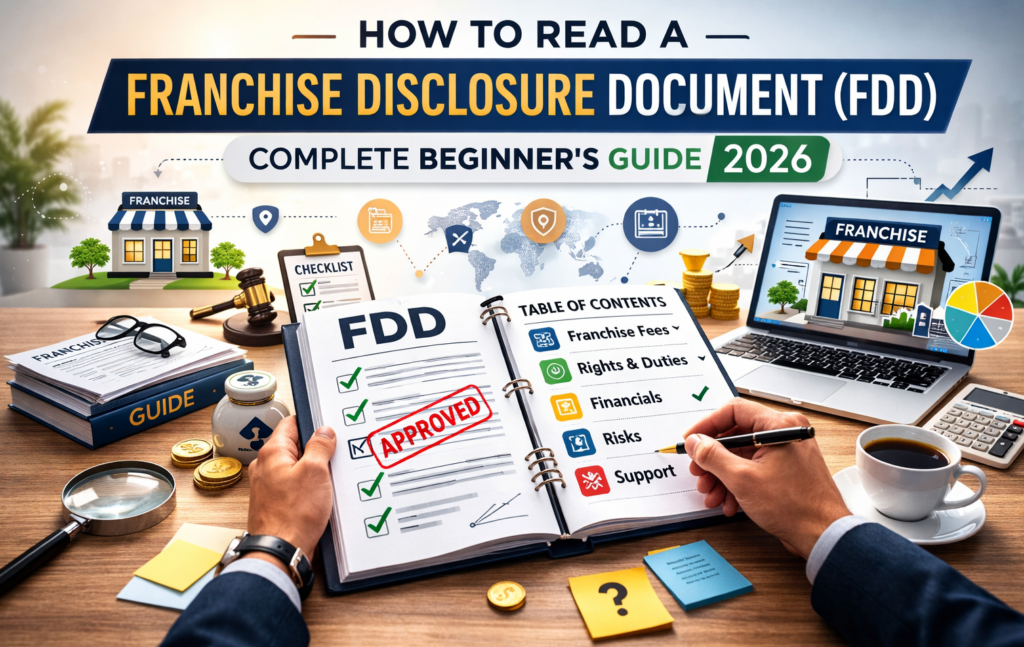
What Is an FDD and Why Does It Matter?
The Franchise Disclosure Document is a legally mandated document that franchisors must provide to prospective franchisees at least 14 days before signing any agreement or accepting payment. Created under the Federal Trade Commission’s Franchise Rule, the FDD standardizes how franchisors disclose critical information about their business system.
Think of the FDD as the franchise’s résumé, financial statement, and warning label all rolled into one. It reveals the franchisor’s track record, financial health, legal disputes, costs, restrictions, and actual performance data from existing franchisees. Learning how to read an FDD properly gives you transparency that no sales pitch can provide.
Every FDD follows the same 23-item structure, which means once you understand the format, you can evaluate any franchise opportunity using the same framework. This standardization is your advantage—it levels the playing field between slick marketing and actual facts.
The FDD Reading Strategy: Don't Read It Front to Back
Here’s the first thing you need to know about how to read an FDD: don’t read it like a novel. Reading 100+ pages of legal language sequentially is a recipe for burnout and confusion. Instead, use a strategic reading order that prioritizes the information most critical to your decision.
Start With These High-Impact Sections First
Item 19 – Financial Performance Representations: This is where the money reality lives. Many franchisors choose not to include this item, which itself is telling. If it’s there, this section shows actual revenue, expenses, or profit data from existing franchisees. Start here to understand if the numbers justify the investment.
Item 7 – Estimated Initial Investment: This breaks down every dollar you’ll need from franchise fees to equipment, real estate, inventory, and working capital. This is your reality check on total capital requirements. When learning how to read an FDD, comparing Item 7 estimates with Item 19 performance data is critical.
Item 3 – Litigation: Past and current lawsuits tell you a lot about how the franchisor treats franchisees and handles disputes. Multiple lawsuits from franchisees claiming fraud or misrepresentation are red flags you can’t ignore.
Item 20 – Outlets and Franchisee Information: This shows how many franchises opened, closed, transferred, or were terminated. High turnover rates or lots of closures signal trouble. This data helps you calculate the franchise failure rate for that system.
Once you’ve reviewed these priority sections, you’ll have a clearer picture of financial viability, risk exposure, and system stability. Then you can work through the remaining items with proper context.
Breaking Down the FDD: All 23 Items Explained
Understanding how to read an FDD means knowing what each item reveals and what questions to ask. Here’s a practical breakdown of all 23 items and what actually matters in each section.
Item 1: The Franchisor and Any Parents, Predecessors, and Affiliates
This section introduces the franchisor’s corporate structure, business history, and affiliated companies. Look for how long they’ve been in business, whether they operate company-owned units, and if they have experience in franchising. A franchisor with no operating experience or a brand-new franchise system carries more risk than an established brand with decades of history.
Item 2: Business Experience
This lists the backgrounds of key executives and officers. When reviewing how to read an FDD, check whether leadership has franchise industry experience, relevant operational expertise, and a stable tenure. Frequent executive turnover or leaders with no franchising background can indicate instability.
Item 3: Litigation
All material litigation involving the franchisor, its executives, or affiliates must be disclosed. Look for patterns: Are franchisees suing for fraud, misrepresentation, or failure to support? Are there government actions or regulatory violations? One lawsuit might be normal, but a pattern of similar complaints is a serious warning sign.
Item 4: Bankruptcy
Any bankruptcies involving the franchisor or its key personnel in the past 10 years must be disclosed. While a past bankruptcy doesn’t automatically disqualify a franchise, it’s a data point to weigh carefully, especially if recent.
Item 5: Initial Fees
This details the initial franchise fee and any other upfront payments required before opening. Note whether the fee is refundable, how it compares to competitors, and if there are discounts for veterans, multi-unit agreements, or other circumstances. Understanding how to read an FDD includes knowing exactly what these fees cover.
Item 6: Other Fees
This is where ongoing royalties, marketing fees, technology fees, and other recurring costs are disclosed. Pay close attention to royalty structures (flat fee vs. percentage of gross sales), required advertising contributions, and any fees that seem unusually high or vague. These ongoing fees directly impact your profitability.
Item 7: Estimated Initial Investment
This provides a range of total investment costs from low to high. It includes everything from the franchise fee to real estate, construction, equipment, initial inventory, insurance, licenses, and working capital for the first three months. Cross-reference these numbers with Item 19 to assess whether the revenue potential justifies the capital outlay. When figuring out how to read an FDD, this is your budget blueprint.
Item 8: Restrictions on Sources of Products and Services
This reveals what you must purchase from the franchisor or approved suppliers, and whether the franchisor earns rebates or commissions from those purchases. Excessive restrictions can limit your ability to control costs and find better suppliers.
Item 9: Franchisee's Obligations
This is a reference table pointing to sections of the franchise agreement that outline your obligations. It’s a roadmap to understanding the legal commitments you’ll make. Use this to navigate the franchise agreement more efficiently.
Item 10: Financing
If the franchisor offers direct financing or has relationships with lenders, it’s disclosed here. Note the terms, interest rates, and any personal guarantees required. Most franchisors don’t offer financing, so you’ll need to pursue SBA loans or other funding independently.
Item 11: Franchisor's Assistance, Advertising, Computer Systems, and Training
This is one of the longest and most important sections. It details pre-opening support, initial training, ongoing operational assistance, marketing programs, required technology systems, and site selection help. When learning how to read an FDD, evaluate whether the support matches the complexity of the business model and whether training seems adequate.
Item 12: Territory
This defines your protected territory (if any) and the franchisor’s rights to open competing locations nearby. Lack of territorial protection means the franchisor could open another franchise or company-owned store right next to yours. This is a critical section for long-term viability.
Item 13: Trademarks
This discloses the franchisor’s trademarks, whether they’re registered with the USPTO, and any disputes or limitations. You’re licensing the brand’s intellectual property, so you need to confirm it’s legally protected and not subject to challenges.
Item 14: Patents, Copyrights, and Proprietary Information
If the franchise system relies on patented processes, proprietary recipes, or copyrighted materials, they’re disclosed here. Understand what intellectual property you’re licensing and any limitations on its use.
Item 15: Obligation to Participate in the Actual Operation of the Franchise Business
This states whether you must personally manage the franchise or if you can hire a manager. If you’re seeking a semi-absentee or investor model, this section clarifies what’s allowed. When considering how to read an FDD for passive income opportunities, Item 15 is essential.
Item 16: Restrictions on What the Franchisee May Sell
This outlines any limits on products, services, or customer types you can serve. Some franchisors restrict online sales, limit your service radius, or prohibit certain revenue streams. Know these restrictions before committing.
Item 17: Renewal, Termination, Transfer, and Dispute Resolution
This is arguably the most legally complex section and one of the most important when understanding how to read an FDD. It covers your rights to renew the franchise, conditions under which the franchisor can terminate your agreement, rules for selling or transferring your franchise, and mandatory arbitration or mediation clauses. Pay special attention to non-compete clauses that restrict what you can do after leaving the franchise.
Item 18: Public Figures
If the franchisor uses celebrity endorsements or public figures in marketing, they must be disclosed here, along with compensation details. This helps you assess whether brand recognition comes from the business model or paid celebrity influence.
Item 19: Financial Performance Representations
This is the section everyone wants but not all franchisors provide. If included, Item 19 shows actual financial data from existing franchisees—revenue, expenses, profit margins, or other performance metrics. When learning how to read an FDD, approach Item 19 carefully: understand what’s included, what’s excluded, how many franchisees achieved the results, and what assumptions underlie the data. If Item 19 is absent, you’ll need to conduct thorough validation calls with existing franchisees to estimate realistic financial performance.
Item 20: Outlets and Franchisee Information
This section provides tables showing the number of franchises opened, closed, transferred, and terminated over the past three years, broken down by state. It also includes contact information for current and former franchisees. High closure rates or lots of terminations are red flags. Use this data to calculate turnover and reach out to franchisees who left the system to understand why.
Item 21: Financial Statements
The franchisor must include audited financial statements for the past three years. Review these to assess the franchisor’s financial health, liquidity, debt levels, and profitability. A franchisor in financial distress may struggle to support franchisees, invest in marketing, or fulfill contractual obligations.
Item 21: Financial Statements
The franchisor must include audited financial statements for the past three years. Review these to assess the franchisor’s financial health, liquidity, debt levels, and profitability. A franchisor in financial distress may struggle to support franchisees, invest in marketing, or fulfill contractual obligations.
Item 22: Contracts
This section includes copies of all agreements you’ll sign—franchise agreement, lease agreements, personal guarantees, and any other contracts. When figuring out how to read an FDD, don’t skip these. Have an attorney review the franchise agreement specifically for terms that seem overly restrictive or one-sided.
Item 23: Receipts
This is simply an acknowledgment page confirming you received the FDD at least 14 days before signing anything or paying money. You’ll sign two copies—one for your records, one for the franchisor. This protects both parties legally.
Red Flags to Watch for When Reading an FDD
Knowing how to read an FDD also means recognizing warning signs that should make you pause or walk away. Here are the most critical red flags:
No Item 19 Financial Performance Representations: While not legally required, the absence of Item 19 means the franchisor either doesn’t track franchisee performance or doesn’t want to share it. This forces you to rely entirely on franchisee validation for financial expectations.
High Franchisee Turnover in Item 20: If you see many closures, terminations, or transfers, especially in the first few years, it suggests franchisees are struggling or dissatisfied. Calculate the percentage of franchises that failed within three years.
Pattern of Litigation in Item 3: Multiple lawsuits from franchisees alleging fraud, misrepresentation, or lack of support indicate systemic problems. One or two disputes might be normal, but a pattern is a deal-breaker.
Vague or Excessive Fees in Item 6: Watch for fees that aren’t clearly defined, that give the franchisor broad discretion to increase costs, or that seem disproportionately high compared to competitors.
Weak Territory Protection in Item 12: If you don’t have exclusive territory rights, the franchisor can saturate your market and cannibalize your sales. This is especially problematic in retail or service-based franchises.
Poor Financial Health in Item 21: If the franchisor’s financial statements show declining revenue, mounting debt, or negative cash flow, they may not be able to support franchisees long-term or invest in brand development.
Overly Restrictive Terms in Item 17: Non-compete clauses that last years and cover broad geographic areas, one-sided termination rights, or transfer restrictions that make it nearly impossible to sell your franchise are all red flags.
How to Use the FDD in Franchisee Validation Calls
Reading the FDD is only half the process. The other half is using the information to guide validation calls with current and former franchisees. When you understand how to read an FDD, you know exactly what questions to ask:
Ask about the accuracy of Item 7 estimates. Did their actual initial investment fall within the disclosed range, or were there surprise costs? Ask about Item 19 financial performance. Are existing franchisees hitting the disclosed numbers, exceeding them, or falling short? For franchises without Item 19, ask directly about revenue, profit margins, and break-even timelines.
Inquire about Item 11 support. Does the franchisor deliver the promised training, marketing, and operational assistance, or do franchisees feel abandoned after opening? Ask about Item 6 fees. Do ongoing royalties and advertising contributions feel fair relative to the value provided, or do franchisees feel nickeled and dimed?
Talk to franchisees who left the system (listed in Item 20). Why did they close or transfer? Would they do it again? What do they wish they had known before signing?
These validation conversations, informed by your FDD review, give you real-world context that no document alone can provide.
Working With Professionals: Franchise Attorney and Accountant
Even after learning how to read an FDD yourself, it’s essential to have professionals review it. A franchise attorney can identify legal risks, unfavorable contract terms, and compliance issues that aren’t obvious to non-lawyers. They’ll review Items 17 and 22 especially closely to protect your interests.
A franchise accountant or CPA can analyze Item 19 financial performance representations (if available), review the franchisor’s financial statements in Item 21, and help you model realistic cash flow projections based on Item 7 investment costs and Item 6 ongoing fees.
These professional reviews typically cost $2,000 to $5,000 total but can save you from a six-figure mistake. Think of it as insurance on your investment.
Common FDD Mistakes Prospective Franchisees Make
Understanding how to read an FDD means avoiding common pitfalls. Many prospective franchisees make these mistakes:
Skipping the FDD entirely and relying on sales presentations: Franchise salespeople are trained to highlight benefits and downplay risks. The FDD contains the unfiltered facts.
Reading only Item 19 and Item 7: While these are critical, ignoring Items 3, 6, 12, 17, and 20 can lead to unpleasant surprises after you’ve already invested.
Not comparing multiple FDDs: Reading one FDD doesn’t give you context. Compare fee structures, support levels, territory rights, and financial performance across multiple franchise opportunities to understand what’s standard and what’s exceptional.
Failing to verify FDD claims with franchisees: The FDD shows what the franchisor says is true. Validation calls reveal what’s actually true in practice.
Ignoring red flags because you’re emotionally invested: Confirmation bias is real. If you’ve fallen in love with the brand, you might dismiss warning signs in the FDD. Stay objective.
Not having the FDD reviewed by professionals: Legal and financial review isn’t optional. It’s a necessary step in due diligence.
Your FDD Reading Checklist
To make sure you’re reading the FDD thoroughly, use this checklist:
- Review Item 19 (Financial Performance Representations) if available—understand what the numbers include and exclude
- Analyze Item 7 (Estimated Initial Investment) and confirm you have adequate capital plus contingency funds
- Examine Item 3 (Litigation) and Item 4 (Bankruptcy) for red flags in the franchisor’s legal history
- Study Item 20 (Outlets and Franchisee Information) to calculate turnover and closure rates
- Review Item 6 (Other Fees) to understand ongoing cost obligations and how they compare to competitors
- Assess Item 11 (Franchisor’s Assistance) to evaluate training and support quality
- Check Item 12 (Territory) for territorial protection and exclusivity terms
- Read Item 17 (Renewal, Termination, Transfer, Dispute Resolution) carefully with legal counsel
- Analyze Item 21 (Financial Statements) to confirm the franchisor’s financial stability
- Review the franchise agreement in Item 22 with a franchise attorney before signing anything
- Contact current and former franchisees listed in Item 20 to validate FDD claims
- Compare this FDD with FDDs from competing franchises in the same industry
Working through this checklist ensures you’ve covered all critical areas and aren’t making a decision based on incomplete information.
Final Thoughts: The FDD Is Your Most Powerful Tool
Learning how to read an FDD is one of the most valuable skills you can develop as a prospective franchisee. Yes, it’s long. Yes, it’s dense. Yes, it requires focus and time. But it’s also the most transparent, regulated, and informative document you’ll receive in the franchise buying process.
The FDD removes the guesswork. It replaces marketing hype with legal disclosures. It gives you the data you need to make an informed investment decision. And when you know how to read an FDD strategically—prioritizing high-impact sections, spotting red flags, and using it to guide validation—you dramatically reduce your risk.
Don’t rush this process. Don’t let a sales timeline pressure you into signing before you’ve fully absorbed the FDD. Take the full 14 days (or longer if needed). Work with professionals. Ask tough questions. Compare options.
The FDD is your protection. Use it.
FAQ SECTION
Most FDDs are 100-200 pages long. A thorough review typically takes 6-10 hours spread over several days. You don't need to read it in one sitting—use a strategic approach, starting with high-priority sections like Item 19, Item 7, Item 3, and Item 20, then working through the rest methodically. Plan to dedicate at least a week to reviewing, researching, and discussing the FDD with advisors.
While you can read the FDD yourself, it's strongly recommended to have a franchise attorney review it, especially Items 17 and 22 (the franchise agreement). Attorneys identify legal risks, unfavorable contract terms, and compliance issues that non-lawyers typically miss. The cost of legal review ($1,500-$3,000) is minimal compared to the risk of signing a bad agreement.
The FTC does not require franchisors to provide Item 19, and many choose not to disclose financial performance representations. If Item 19 is absent, you must rely on validation calls with existing franchisees to gather realistic revenue and profit expectations. Ask specific questions about gross revenue, operating expenses, net profit, and how long it took to reach break-even. Without Item 19, your due diligence process becomes more intensive but is still entirely possible.
Key red flags include: multiple lawsuits from franchisees (Item 3), high closure or termination rates (Item 20), absence of Item 19 financial data when competitors provide it, weak or no territorial protection (Item 12), vague or excessive ongoing fees (Item 6), poor franchisor financial health (Item 21), and overly restrictive contract terms (Item 17). If you see multiple red flags, reconsider the opportunity or seek expert guidance.
In most cases, franchise agreements are non-negotiable, especially with established franchise systems. However, some franchisors may negotiate on certain points like territory size, payment schedules, or multi-unit discounts. Items related to franchise fees, royalties, and core contract terms are typically standardized. If you identify concerning terms in Items 17 or 22, discuss them with the franchisor, but be prepared that changes may not be possible. This is why thorough review before signing is critical.
Franchisors must update the FDD at least annually and provide it to prospective franchisees within 14 days of their first personal meeting or 14 days before signing any agreement or making any payment, whichever comes first. Material changes (like litigation, bankruptcies, or fee increases) may trigger mid-year updates. Always confirm you have the most recent FDD version before making decisions.
The FDD is a disclosure document required by the FTC that explains the franchise opportunity, costs, obligations, and risks. The franchise agreement (included in Item 22) is the binding legal contract that defines your relationship with the franchisor. The FDD describes what you're getting into; the franchise agreement is what you're legally signing. Both must be reviewed carefully, but the franchise agreement is the enforceable contract.
Absolutely. Comparing FDDs from multiple franchises in the same industry helps you understand what's standard vs. what's exceptional. Compare Item 6 fees, Item 7 investment costs, Item 11 support levels, Item 12 territory rights, Item 19 financial performance (if available), and Item 20 turnover rates. This comparative analysis gives you leverage to ask better questions and make more informed choices.
If a franchisor makes false statements in the FDD or fails to disclose required information, you may have legal recourse under federal and state franchise laws. Violations can result in contract rescission, damages, or regulatory penalties. This is another reason why keeping a copy of the FDD and documenting all promises is essential. If you discover discrepancies between the FDD and actual practice, consult a franchise attorney immediately.
Yes. You should absolutely ask the franchisor to clarify anything in the FDD that's unclear or seems inconsistent. Document these conversations in writing (email is best) so you have a record. However, don't rely solely on verbal explanations—if something critical isn't in the FDD or franchise agreement, it's not legally binding. Always work with a franchise attorney to interpret complex legal language.
Latest Posts
What Franchise Break-Even Timeline Really Reveals About ROI
5 Questions to Ask During Franchise Validation Calls
The Real Cost of Buying a Franchise: What Most Buyers Don’t See Until It’s Too Late
Franchise vs. Starting a Business: Which Path Is Right for You?
How to Read a Franchise Disclosure Document (FDD): Complete Beginner’s Guide 2026
Subscribe To Newsletter
Get practical franchise insights—financing, red flags, trends, and decision frameworks—straight to your inbox.
No spam. No sales pitches. Just clarity.