
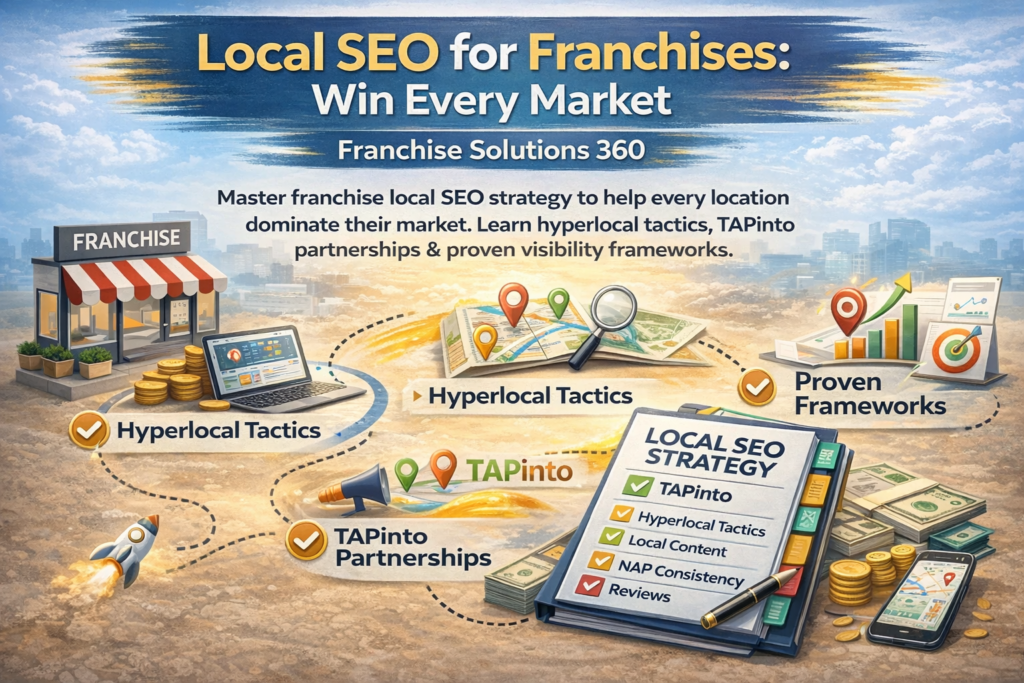
Local SEO for Franchises: Win Every Market | Franchise Solutions 360
Blucorp is now available worldwide. Create Your Account today.
Local SEO for Franchises: Win Every Market | Franchise Solutions 360
Local SEO for Franchise Brands: How to Help Your Franchisees Win in Their Markets
You’ve built a scalable franchise system. You’ve recruited qualified franchisees. You’ve provided training, operations manuals, and brand standards. But here’s the reality most franchisors discover too late: none of that matters if your franchisees can’t be found by customers in their local markets.
A strong franchise local SEO strategy isn’t optional anymore—it’s the difference between franchisees who thrive and those who struggle to break even. When your franchise locations don’t show up in local search results, Google Maps, or “near me” searches, you’re not just losing leads. You’re eroding franchisee confidence, increasing turnover, and limiting your brand’s growth potential.
The good news? Multi-location brands have unique advantages when it comes to local search visibility. The challenge is implementing a coordinated strategy that works across dozens or hundreds of locations without creating chaos, duplicate content penalties, or brand inconsistency.
Why Most Franchise Brands Fail at Local SEO
Most franchise systems make one of three critical mistakes when approaching local search:
The Corporate-Only Approach: Marketing teams manage everything centrally, creating cookie-cutter content that lacks local relevance. Franchisees feel disconnected from the strategy and don’t engage with local marketing opportunities.
The Total Freedom Model: Franchisees control their own digital presence with minimal guidance. This creates brand inconsistency, duplicate content issues, and vastly different levels of search performance across territories.
The “Set It and Forget It” Trap: Someone sets up Google Business Profiles at launch, creates basic location pages, then moves on. No ongoing optimization, no review management, no local content strategy.
Each approach fails because effective local SEO for franchises requires both corporate consistency and local customization. You need brand control without suffocating local relevance. You need scalable systems that still feel personal to each market.
The Three-Pillar Framework for Franchise Local SEO Strategy
The most successful franchise brands structure their approach around three core pillars: Technical Foundation, Local Relevance, and Community Authority. Each pillar serves a specific purpose and requires different resources and responsibilities.
Pillar 1: Technical Foundation (Corporate Responsibility)
This is what corporate must own and execute flawlessly:
Location Landing Pages That Actually Convert
Each franchisee needs a dedicated location page that’s properly structured for local search. This isn’t just slapping an address on a template. It means unique content that combines brand messaging with genuine local context, schema markup that tells search engines exactly what services are available at this specific location, and conversion elements designed for local customer behavior.
Google Business Profile Management at Scale
Your franchise’s search visibility lives or dies by Google Business Profile performance. Every location needs accurate NAP (Name, Address, Phone) data, complete business categories and attributes, regular posting schedules, and active review response. The mistake most brands make? Treating this as a one-time setup task instead of ongoing relationship building with Google’s local algorithm.
Review Generation and Management Systems
Reviews aren’t just reputation management—they’re ranking signals. Implement automated review request systems triggered by customer interactions, centralized monitoring that alerts franchisees to new reviews within hours, response templates that maintain brand voice while allowing personalization, and quarterly reporting that ties review metrics to local search performance.
Local Link Building Infrastructure
Build partnerships that benefit all locations: directory submissions across business aggregators, association memberships that create authoritative backlinks, franchise-wide sponsorships that scale local link equity, and corporate PR that generates brand mentions franchisees can leverage.
Pillar 2: Local Relevance (Franchisee Empowerment)
Give your franchisees the tools and training to own their local presence:
Localized Content Creation Frameworks
Franchisees need simple templates for creating locally relevant content: neighborhood spotlight blog posts, local event participation announcements, community involvement stories, and seasonal service variations that matter to their specific market. The key is providing structure without requiring marketing expertise.
Social Media Localization
Corporate social media builds brand. Local social media drives foot traffic. Help franchisees maintain active Facebook and Instagram presence featuring real customers, local team spotlights, community events, and market-specific promotions. Provide content calendars, hashtag strategies, and posting guidelines that protect brand consistency while encouraging local authenticity.
Hyperlocal Keyword Optimization
Every market has unique search patterns. Train franchisees to identify and optimize for terms like “[city name] + [service],” “[neighborhood] + [franchise type],” “best [franchise category] near [local landmark],” and seasonal variations that matter to their specific customer base.
Pillar 3: Community Authority (Strategic Partnerships)
This is where franchise brands can create massive competitive advantages through strategic local partnerships:
The Power of Hyperlocal News Partnerships: The TAPinto Advantage
One of the most underutilized yet powerful strategies in franchise local SEO strategy is partnering with hyperlocal online news platforms. While most brands chase placement in regional newspapers or industry publications, the real SEO gold lies in community-focused news websites—and TAPinto represents the gold standard for this approach.
What Makes TAPinto Different
TAPinto operates as a network of community news websites serving specific towns and regions across New Jersey, Pennsylvania, and expanding into other markets. Each TAPinto site is hyperlocal, covering everything from town council meetings to high school sports, local business openings to community events. Here’s why this matters for your franchise SEO:
Genuine Community Trust and Readership
TAPinto readers are highly engaged local residents who check the site multiple times per week for community news. When your franchisee appears in TAPinto coverage, you’re reaching people who actually live and shop in that specific market. This isn’t random traffic—it’s your exact target audience in the exact geography you need to dominate.
Powerful Local SEO Benefits
Every TAPinto mention creates valuable local signals for search engines: high-authority backlinks from genuinely local domains, geographic relevance that reinforces your franchisee’s market connection, contextual content that includes natural local keywords, and social sharing within community-focused networks. Google’s local algorithm weighs these signals heavily because they prove genuine community involvement.
Multiple Touchpoint Opportunities
Unlike one-time press releases, TAPinto relationships create ongoing visibility: franchisee profiles when locations open, community event sponsorship coverage, expert commentary on industry trends affecting the local market, seasonal tips and advice positioning franchisees as local resources, and feel-good stories about community involvement or charitable work.
How to Leverage TAPinto for Franchisee Success
Grand Opening and Launch Coverage
Work with TAPinto editors to create compelling launch stories. These typically include franchisee background and local connection, services specifically relevant to the community, opening promotions or community offers, and photo opportunities with local officials or community leaders. A well-placed grand opening story creates an immediate local authority signal.
Ongoing Editorial Relationships
The biggest mistake brands make is treating hyperlocal news as one-and-done. Build sustained relationships by offering seasonal expert tips (plumbers offer winterization advice, fitness franchises cover post-holiday wellness), sponsoring community sections or recurring columns, providing timely commentary on local issues related to your industry, and participating in TAPinto’s event calendars and community directories.
Community Involvement Amplification
When franchisees sponsor Little League teams, participate in town festivals, or support local charities, TAPinto coverage turns these activities into SEO assets. The coverage creates authoritative backlinks, social proof within the community, searchable content including local keywords, and shareable stories that extend reach beyond the initial publication.
Crisis and Reputation Management
When handled properly, TAPinto relationships provide insurance against reputation challenges. Local news coverage of how franchisees handled service issues, community concerns, or operational challenges creates authoritative narratives that outrank negative reviews in search results.
Measuring TAPinto Partnership ROI
Track these metrics to justify hyperlocal news investment:
Direct SEO Impact:
- Referring domain authority gains
- Local pack ranking improvements post-publication
- Organic traffic from TAPinto referrals
- Keyword ranking changes for location-based terms
Broader Market Impact:
- Google Business Profile views and actions
- Branded search volume in the franchisee’s market
- Review volume and sentiment changes
- Phone calls and form submissions attributed to news coverage
Building Your Franchise-Wide Local SEO Implementation System
The difference between strategic planning and actual results is implementation. Here’s the execution framework successful franchise brands use:
Phase 1: Audit and Baseline (Weeks 1-2)
Conduct comprehensive local SEO audits across all locations. Identify top performers, struggling markets, and the specific gaps between them. Measure current Google Business Profile rankings, local pack visibility, review ratings and volume, organic traffic to location pages, and local keyword rankings for target terms.
Phase 2: Technical Cleanup (Weeks 3-6)
Fix foundational issues before building new strategies. This means correcting NAP inconsistencies across directories, implementing proper schema markup on location pages, claiming and verifying all Google Business Profiles, removing duplicate listings that dilute authority, and establishing consistent URL structures for location pages.
Phase 3: Corporate Infrastructure (Weeks 7-10)
Build the systems franchisees will use: centralized review monitoring and response platform, content templates for local blog posts and social media, training materials on local SEO best practices, reporting dashboards showing each location’s search performance, and partnership development with hyperlocal media like TAPinto.
Phase 4: Franchisee Enablement (Weeks 11-14)
Train and empower location owners to execute locally: mandatory training on Google Business Profile optimization, content creation workshops with local examples, review generation and response protocols, social media posting guidelines and schedules, and monthly coaching calls to troubleshoot challenges.
Phase 5: Partnership Activation (Weeks 15-18)
Launch community authority initiatives: identify TAPinto markets or similar hyperlocal platforms in each territory, develop story angles and editorial calendars, coordinate launch coverage for new locations, establish ongoing contributor or expert relationships, and track coverage impact on local search performance.
Phase 6: Optimization and Scaling (Ongoing)
Continuously improve based on performance data: monthly performance reviews comparing locations, A/B testing of local content approaches, expansion of successful tactics across territories, franchisee recognition programs for SEO excellence, and quarterly strategy adjustments based on algorithm changes and competitive shifts.
Common Franchise Local SEO Mistakes (And How to Avoid Them)
Mistake #1: Treating All Locations Identically
What works in a suburban market doesn’t work downtown. Customize strategies for market demographics, local competition intensity, seasonal variation patterns, and community culture and engagement styles.
Mistake #2: Ignoring Franchisee Buy-In
The best strategy fails if franchisees don’t execute. Build buy-in through transparent reporting showing ROI, recognition systems for top performers, peer learning opportunities, and simple, documented processes that don’t require marketing expertise.
Mistake #3: Overlooking Mobile and “Near Me” Optimization
Over 70% of local searches happen on mobile devices. Ensure mobile page speed under 3 seconds, click-to-call functionality on all location pages, mobile-friendly forms and CTAs, and voice search optimization for conversational queries.
Mistake #4: Neglecting Local Content Quality
Thin, duplicate content kills local search performance. Every location needs genuinely useful local information, unique insights about serving that specific market, original photos from the actual location, and regular content updates demonstrating active business engagement.
The Future of Franchise Local SEO
As artificial intelligence reshapes search behavior, franchise brands need to prepare for these emerging trends:
AI-Powered Search Assistants
ChatGPT, Google’s Search Generative Experience, and other AI tools are changing how people find local businesses. Optimize for AI by ensuring structured data is comprehensive and accurate, content directly answers common customer questions, Google Business Profiles are completely filled out, and review responses demonstrate genuine customer care.
Zero-Click Searches
More searches end without website clicks as Google displays answers directly. Win zero-click visibility through featured snippet optimization, FAQ schema markup, comprehensive Google Business Profile posts, and authoritative local content.
Hyper-Personalization
Search engines increasingly personalize results based on user behavior, preferences, and history. Stand out through authentic review volume and quality, consistent social media presence, local event and community participation, and personalized customer experiences that generate word-of-mouth.
Making the Decision: DIY, Agency, or Hybrid Approach?
Most franchise brands face a key question: who should manage local SEO execution?
DIY Corporate Management
Works when you have dedicated internal resources, relatively few locations (under 50), strong franchisee relationships and communication, and technical SEO expertise in-house.
Full-Service Agency Partnership
Makes sense for rapid scaling (50+ locations), limited internal marketing resources, complex competitive markets, and brands prioritizing speed over cost.
Hybrid Model (Most Common)
Corporate manages technical foundation and standards, agencies handle scalable implementation and reporting, franchisees execute local community engagement, and everyone focuses on their core strengths.
Conclusion: Local SEO as Franchisee Success Insurance
The most successful franchise brands don’t view local SEO for franchises as a marketing tactic—they see it as franchisee success insurance. When you invest in comprehensive local search visibility, you’re not just driving website traffic. You’re giving franchisees the tools to compete with established local businesses, reducing new franchisee time-to-profitability, creating measurable competitive advantages in their territories, and building long-term brand value across every market you serve.
The question isn’t whether local SEO matters for your franchise system. The question is whether you’re giving your franchisees the support they need to win in their specific markets against competitors who are already executing sophisticated local search strategies.
Hyperlocal partnerships like TAPinto, combined with technical excellence and franchisee empowerment, create a moat that’s nearly impossible for competitors to cross. Start building that advantage today.
Need help building a franchise local SEO strategy that scales across your entire system? Contact Franchise Solutions 360 for a consultation on how we can support your franchisees’ local market success.
Frequently Asked Questions
Franchise local SEO strategy is the coordinated approach to improving search visibility for each individual franchise location in their specific geographic market. It matters because 46% of all Google searches are seeking local information, and 76% of people who search for something nearby visit a business within 24 hours. Without strong local SEO, franchisees become invisible to customers actively searching for their services.
Franchise SEO requires balancing brand consistency across all locations with localized content and community engagement for each market. You need scalable systems that work for 10, 50, or 500 locations while allowing enough customization to compete effectively in each territory. Regular local SEO typically focuses on a single business location.
The most effective approach is shared management: franchisors maintain ownership and access to prevent rogue franchisees from harming the brand, franchisees have manager-level access to post updates and respond to reviews, corporate monitors all activity and enforces brand standards, and both parties collaborate on optimization strategies.
Hyperlocal news partnerships involve collaborating with community-focused online publications like TAPinto that serve specific towns or regions. These partnerships improve SEO by creating high-authority backlinks from genuinely local domains, generating content with natural local keywords and geographic context, building social proof within the exact community your franchisee serves, and creating multiple touchpoints throughout the year through ongoing coverage
Technical fixes like correcting NAP data and implementing schema markup can show results within 2-4 weeks. Building sustainable local authority through content, reviews, and partnerships typically requires 3-6 months for measurable improvement. The strongest franchise locations usually see significant search visibility gains within 6-12 months of consistent effort.
TAPinto is a network of hyperlocal news websites serving specific communities primarily in New Jersey and Pennsylvania, with expansion into other markets. Franchise brands should care because TAPinto sites have loyal, engaged readers who are actual residents of the markets your franchisees serve. Coverage in TAPinto provides powerful local SEO signals, community credibility, and direct access to your target customers in specific geographic territories.
Investment levels vary, but successful franchise systems typically allocate 2-4% of systemwide revenue to marketing support that includes local SEO infrastructure. This might include $2,000-$5,000 per location annually for technical setup and ongoing optimization, centralized tools and platforms for review management and reporting, training and support resources, and partnership development with platforms like hyperlocal news sites.
Yes, when properly structured. Google's local algorithm shows results based on the searcher's location and proximity to businesses. A search for "Italian restaurant" in Newark will show different results than the same search in Princeton, even for the same franchise brand. The key is ensuring each location has unique content optimized for their specific market, distinct Google Business Profiles with complete information, and geographic terminology that clearly differentiates territories.
The biggest mistake is treating local SEO as a launch task rather than an ongoing system. Brands set up location pages and Google Business Profiles when franchisees open, then provide no ongoing support, training, or optimization. Local SEO requires consistent effort in review management, content creation, community engagement, and technical optimization. Franchises that treat it as "set and forget" consistently underperform competitors who invest in continuous improvement.
Not Sure Which Path Is Right for You?
Franchise Solutions 360 offers an education-first franchise consulting process — no pressure, no sales pitch. We help you evaluate both paths honestly, understand true costs, and build a decision framework based on your goals, capital, and risk profile.
Latest Posts
What Franchise Break-Even Timeline Really Reveals About ROI
5 Questions to Ask During Franchise Validation Calls
The Real Cost of Buying a Franchise: What Most Buyers Don’t See Until It’s Too Late
Franchise vs. Starting a Business: Which Path Is Right for You?
How to Read a Franchise Disclosure Document (FDD): Complete Beginner’s Guide 2026
Subscribe To Newsletter
Get practical franchise insights—financing, red flags, trends, and decision frameworks—straight to your inbox.
No spam. No sales pitches. Just clarity.