

Local SEO for Franchises: Win Every Market | Franchise Solutions 360
Blucorp is now available worldwide. Create Your Account today.
What Franchise Break-Even Timeline Really Reveals About ROI
1 What the Break-Even Timeline on a Franchise Really Tells You About the Opportunity
Understanding the franchise break-even timeline is critical for evaluating opportunity quality, managing capital risk, and setting realistic expectations.
When you’re evaluating a franchise opportunity, one number matters more than almost any other: the franchise break-even timeline. This single metric reveals the quality of the business model, the realism of financial projections, and the amount of working capital you’ll actually need to survive the startup phase.
But here’s what most prospective franchisees get wrong: they treat the break-even timeline as a simple countdown to profitability rather than what it really is—a comprehensive risk and opportunity signal that tells you whether the franchise model is designed for sustainable success or set up for early failure.
In this guide, we’ll decode what the franchise break-even timeline actually reveals about the opportunity in front of you, how to validate the numbers you’re being shown, and what a realistic timeline should look like across different franchise models and industries.
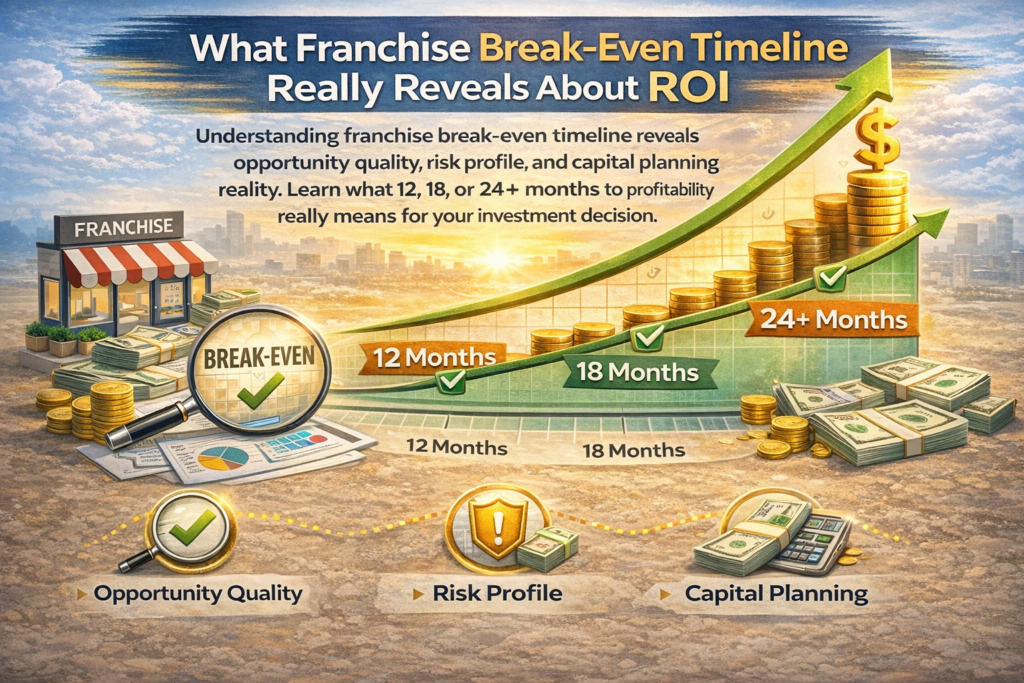
What the Franchise Break-Even Timeline Actually Measures
The franchise break-even timeline represents the point at which your total revenue equals your total expenses—meaning you’re no longer losing money each month, but you’re not yet making a profit either. It’s the financial inflection point where cash outflow stops and cash generation begins.
Here’s what makes understanding the franchise break-even timeline more complex than it appears: break-even doesn’t mean you’ve recouped your initial investment. It means your monthly operating revenue now covers your monthly operating expenses. Your total investment recovery—including franchise fees, buildout costs, equipment, and working capital—comes later, often much later.
The Three Types of Break-Even Metrics Franchises Use
When franchisors discuss the franchise break-even timeline, they may be referring to different calculations:
Cash Flow Break-Even: The point where monthly revenue covers monthly expenses, including debt service. This is the most conservative and realistic measure because it accounts for loan payments.
Operating Break-Even: The point where revenue covers operating expenses but may not include debt service, depreciation, or owner compensation. This metric can be misleading if you’re comparing franchises.
EBITDA Break-Even: Earnings before interest, taxes, depreciation, and amortization. This is often the rosiest picture and may not reflect your actual cash position.
When evaluating any franchise opportunity, always clarify which break-even definition the franchisor is using in their Item 19 financial performance representations.
What the Franchise Break-Even Timeline Reveals About Opportunity Quality
The franchise break-even timeline isn’t just a number—it’s a window into the fundamental health and design of the business model. Here’s what different timelines actually signal:
6-12 Month Break-Even Timeline: High-Velocity, Lower Capital Models
Franchises that reach break-even within six to twelve months typically share specific characteristics. They often have lower initial investment requirements (typically $100,000-$300,000), rely on service-based or home-based models with minimal overhead, and generate revenue from day one rather than waiting for buildout or customer acquisition ramps.
Examples include mobile services (detailing, pet grooming, home inspections), consulting or coaching franchises, senior care services, and some food truck or ghost kitchen concepts.
What this timeline tells you: The business model prioritizes speed to profitability over market dominance. Capital efficiency is built into the model. Your personal involvement and sales effort will likely drive early success more than brand recognition alone.
12-18 Month Break-Even Timeline: Traditional Retail and Service Models
This is the most common franchise break-even timeline for brick-and-mortar concepts with moderate complexity. These businesses require customer acquisition time, operational staffing, and market establishment before hitting sustainable volume.
Common examples include quick-service restaurants, fitness studios, retail stores, educational services, and health and wellness centers.
What this timeline tells you: The model requires working capital discipline and realistic expectations. Marketing and operational execution matter significantly. Local market conditions will influence your actual timeline more than in faster models.
18-24+ Month Break-Even Timeline: Capital-Intensive or Market-Building Models
Longer franchise break-even timelines typically indicate high capital investment (often $500,000+), complex operational requirements, longer customer acquisition cycles, or markets that require significant brand building and relationship development.
Examples include full-service restaurants, hotels and hospitality, medical or healthcare franchises, specialty retail with extensive inventory, and franchise models requiring professional licensing or certification.
What this timeline tells you: You need substantial working capital reserves beyond the stated initial investment. The model may offer higher long-term returns but demands patience and financial staying power. Market selection and site choice become critical variables affecting your actual timeline.
36+ Month Timeline or “Undisclosed” Break-Even: Warning Signals
If a franchise’s break-even timeline extends beyond three years, or if the franchisor is vague or unwilling to provide Item 19 financial performance data, proceed with extreme caution.
While some legitimate, capital-intensive industries (certain hospitality or medical franchises) may genuinely require longer timelines, an extended or unclear franchise break-even timeline often signals unproven unit economics, overly optimistic projections, or a business model that hasn’t been sufficiently validated.
The Break-Even Validation Framework: How to Test Timeline Assumptions
Franchisors provide estimated timelines, but your actual franchise break-even timeline will depend on execution, market conditions, and capital management. Here’s how to validate what you’re being told:
Step 1: Review Item 19 Financial Performance Representations
The Franchise Disclosure Document’s Item 19 should provide data on existing franchisee performance. Look for median (not just average) break-even timelines, the percentage of franchisees who achieved break-even within the stated timeframe, and whether data separates first-year units from mature units.
If Item 19 doesn’t exist or provides minimal data, this significantly increases your risk and makes validation even more critical.
Step 2: Conduct Systematic Validation Calls
Contact franchisees at different stages and geographies. Ask specifically: “When did you reach positive monthly cash flow?” and “How much working capital did you actually use before break-even?” and “What factors made your timeline longer or shorter than the estimate?”
Talk to franchisees who opened within the last 12-24 months (their experience is most relevant to your timeline), those in similar market demographics to your target territory, and at least one franchisee who struggled or took longer than expected to understand what can go wrong.
Step 3: Stress Test Your Working Capital Plan
Once you understand the stated franchise break-even timeline, add a 25-50% buffer for planning purposes. If break-even is projected at 12 months, plan for 15-18 months of operating capital.
Calculate total capital needed as: Initial franchise investment + (Monthly operating expenses × Extended timeline months) + 3-6 months additional contingency.
This conservative approach prevents the most common franchise failure scenario: running out of capital before the business model has time to prove itself.
Step 4: Benchmark Against Industry Standards
Research typical franchise break-even timelines for your industry. If your target franchise’s timeline is significantly shorter than industry norms, understand why. Is it genuinely better unit economics, a more efficient model, or overly optimistic projections?
Industry trade associations, franchise research firms, and experienced franchise consultants can provide context on realistic timelines by sector.
How the Franchise Break-Even Timeline Should Shape Your Capital Planning
Understanding your franchise break-even timeline isn’t just about knowing when you’ll stop losing money—it fundamentally shapes how you should structure your financing, manage cash flow, and set personal financial expectations.
Working Capital Reality: The Hidden Investment Multiplier
Here’s a planning framework most franchisees miss: if your franchise break-even timeline is 18 months and your monthly operating expenses are $25,000, you need $450,000 in working capital plus your initial investment. That $450,000 doesn’t include your franchise fee, buildout, or equipment—it’s purely to cover operations until break-even.
Many franchisees underestimate this because they focus on the franchise fee and initial investment while treating working capital as a small line item. In reality, working capital often represents 40-60% of total capital required for franchises with longer break-even timelines.
Financing Strategy Based on Break-Even Profile
For 6-12 month timelines: Consider minimizing debt and maximizing speed. Higher-interest, faster-closing financing may be acceptable since payback period is shorter. Focus financing on initial investment rather than extensive operating reserves.
For 12-18 month timelines: Balance debt and equity carefully. SBA loans make sense for their favorable terms and longer amortization. Ensure you have 6-9 months of operating expenses in liquid reserves beyond debt service.
For 18-24+ month timelines: Prioritize conservative financing with maximum liquidity. Consider delaying launch until you have substantial cash reserves beyond what lenders require. Your margin for error is slim, and running out of capital in month 20 of a 24-month timeline means total loss.
Personal Financial Runway Alignment
Your personal financial situation must align with the franchise break-even timeline. If you need personal income before break-even, you need additional capital beyond business expenses, or an employed spouse or partner providing income stability, or a semi-absentee model where you maintain other income sources.
The franchise break-even timeline represents business cash flow positivity, not personal profit extraction. You may need to wait 3-6 additional months beyond break-even before taking meaningful owner distributions.
Red Flags and Warning Signs in Break-Even Timeline Discussions
How a franchisor discusses the franchise break-even timeline reveals as much as the number itself. Watch for these warning signals:
Vague or Evasive Answers
If the franchisor says “it varies widely” without providing ranges or data, or “some franchisees break even in 6 months” without disclosing what percentage or median timeline, or declines to provide Item 19 data or validation call access, you’re looking at insufficient transparency for informed decision-making.
Best-Case Scenario Positioning
Be cautious if the franchisor emphasizes the fastest-ever break-even story without context, presents timeline based on “ideal market conditions” or “if you follow the system perfectly,” or fails to discuss factors that extend timeline or create challenges.
Reputable franchisors present realistic ranges, acknowledge variables, and connect you with franchisees who experienced different outcomes.
Disconnect Between Timeline and Capital Requirements
A major red flag appears when the stated franchise break-even timeline doesn’t align with working capital guidance. For example, if break-even is 18 months but working capital requirement is listed as $50,000, the math doesn’t work unless monthly expenses are unrealistically low.
Calculate backwards: Does the stated working capital actually cover expenses through the stated break-even timeline plus a reasonable buffer? If not, the numbers aren’t realistic.
Industry Outlier Performance
If a franchise claims a significantly shorter break-even timeline than established competitors or industry norms, dig deeper. Sometimes this reflects genuine innovation or superior unit economics. Often, it reflects aggressive projections that don’t materialize in practice.
Using Break-Even Timeline as a Decision Framework
The franchise break-even timeline should be a central element of your franchise evaluation framework, not an isolated data point. Here’s how to integrate it into your decision-making:
The Timeline-Aligned Risk Assessment
Match your risk tolerance to the timeline profile. Conservative investors with limited capital should favor shorter timelines with proven track records. Risk-tolerant investors with substantial capital reserves can consider longer timelines if potential returns justify the wait. First-time franchisees should generally avoid franchises with break-even timelines exceeding 18 months unless they have exceptional capital cushion.
ROI Calculations Must Include Timeline Reality
When comparing franchises, calculate total return on investment using realistic franchise break-even timelines plus payback periods. A franchise requiring $400,000 investment with 12-month break-even may outperform one requiring $250,000 investment with 24-month break-even, even though the second appears cheaper.
Calculate: Total capital invested ÷ Annual profit after break-even = Years to full ROI. Then consider: Does this timeline align with your wealth-building goals and exit strategy?
Market and Personal Variable Integration
Adjust your break-even timeline expectations based on your specific market demographics and competitive density, your personal business experience and ability to execute, the seasonality of the business model, and your marketing budget and customer acquisition capability.
A franchise with a stated 12-month break-even timeline might take 9 months in your hands in an ideal market, or 16 months if you’re in a more competitive territory or have a learning curve to navigate.
How to Accelerate Your Actual Break-Even Timeline
While the franchise break-even timeline provides guidance, your execution determines reality. Strategic franchisees implement specific approaches to reach break-even faster than projected:
Pre-Launch Marketing and Customer Acquisition
Begin building awareness and capturing customer interest 90-120 days before opening. This shortens the revenue ramp-up period dramatically. Develop local digital presence, build email list of interested prospects, create strategic partnerships before doors open, and leverage franchisor marketing resources during pre-opening phase.
Expense Management in Early Months
Control costs without compromising quality through lean staffing in first months with owner-operator involvement, negotiating favorable payment terms with suppliers, delaying non-essential equipment or service additions, and focusing marketing spend on highest-ROI channels only.
Every dollar of monthly expenses saved multiplied across 12-18 months significantly reduces capital burn and shortens break-even timeline.
Revenue Optimization Strategies
Maximize early revenue through strategies like implementing dynamic pricing based on demand patterns, adding high-margin services or products within brand guidelines, focusing on customer retention and repeat business from day one, and exploring B2B or commercial opportunities alongside consumer sales.
Territory and Site Selection Impact
Your choice of location and territory may have more impact on franchise break-even timeline than any other variable. Prioritize demographics that match the ideal customer profile, accessibility and visibility that drive walk-in or drive-by traffic, competitive analysis that reveals underserved market opportunities, and lease terms that reduce fixed costs during ramp-up period.
Why Professional Guidance Matters for Break-Even Analysis
Understanding franchise break-even timeline requires more than reading the FDD—it demands comprehensive financial analysis, industry context, and validation that most prospective franchisees can’t conduct independently while working full-time or managing other priorities.
At Franchise Solutions 360, we help aspiring franchisees evaluate the franchise break-even timeline across multiple opportunity options, providing: comprehensive working capital modeling that accounts for realistic timelines and market variables, validation call frameworks that extract truth from existing franchisees about actual vs. projected timelines, industry benchmarking to identify outliers and confirm reasonable expectations, financing strategy that aligns capital structure with break-even reality, and risk assessment that helps you choose opportunities matching your financial capacity and timeline tolerance.
We’ve seen too many franchisees run out of capital in month 14 of an 18-month break-even timeline—not because the franchise failed, but because they underestimated working capital needs. Professional guidance helps you avoid this entirely preventable outcome.
Final Thoughts: Break-Even Timeline as Opportunity Decoder
The franchise break-even timeline isn’t just a financial metric—it’s a comprehensive signal about business model quality, capital requirements, risk profile, and execution demands. When you understand what it really reveals, you transform from passive information receiver to active, strategic evaluator.
Here’s what every serious franchise buyer should remember: shorter isn’t always better if it comes with lower returns or unsustainable models. Longer timelines can be worth it if the business model is proven and you have capital staying power. The stated timeline is a starting point for analysis, not a commitment or guarantee. Your actual timeline depends on execution, market conditions, and capital discipline. Professional validation and stress testing separate successful franchisees from those who run out of capital before break-even.
Don’t evaluate franchises based on franchise fees or brand recognition alone. Evaluate them based on realistic break-even timelines, capital requirements to reach that timeline, and your financial capacity to execute the plan with buffer included.
The franchise break-even timeline tells you everything you need to know about whether an opportunity matches your capital reality and risk tolerance—if you know how to read it.
Ready to Evaluate Franchise Opportunities with Confidence?
Don’t make a six-figure investment decision based on incomplete financial analysis or optimistic projections. Franchise Solutions 360 provides comprehensive franchise evaluation that includes break-even timeline validation, working capital modeling, and risk assessment across your top opportunities.
Let’s start with a clarity conversation: We’ll review your capital position, timeline expectations, and target franchise models to determine which opportunities genuinely align with your financial reality. Email us at info@franchisesolutions360.com or visit our services page to learn more about our franchise consulting process.
The right franchise opportunity with realistic break-even timeline expectations can build substantial wealth. The wrong choice—or the right franchise with inadequate capital planning—can cost you everything. Professional guidance makes the difference.
Frequently Asked Questions About Franchise Break-Even Timeline
A good franchise break-even timeline depends on the industry and business model. Generally, 12-18 months is considered reasonable for most brick-and-mortar franchises. Service-based or home-based franchises may break even in 6-12 months, while capital-intensive concepts like full-service restaurants or hotels may take 18-24 months. The "good" timeline is one that's realistic, validated by existing franchisees, and aligned with your capital capacity and risk tolerance.
Plan for working capital equal to monthly operating expenses multiplied by the break-even timeline in months, plus an additional 3-6 months buffer. For example, if break-even is 15 months and monthly expenses are $20,000, you need $300,000-$360,000 in working capital beyond your initial franchise investment. This buffer protects against delays, seasonal fluctuations, or unforeseen challenges.
Treat the franchisor's franchise break-even timeline as an estimate that requires validation, not a guarantee. Review Item 19 financial performance representations in the FDD, conduct validation calls with multiple existing franchisees about their actual timeline, and compare the stated timeline to industry benchmarks and competitor franchises. Always add a 25-50% buffer to stated timelines when planning your capital requirements.
If a franchisor won't disclose break-even timeline information or doesn't provide Item 19 financial performance representations, this significantly increases your investment risk. While not all franchises are required to provide Item 19 data, the lack of transparency makes validation extremely difficult. In this scenario, you must rely entirely on validation calls with franchisees and should proceed with extra caution and conservative capital planning.
No. The franchise break-even timeline indicates when monthly revenue equals monthly expenses—you're no longer losing money each month. However, you haven't yet recovered your initial investment (franchise fee, buildout, equipment, etc.). Full return on investment comes later and depends on post-break-even profitability. You might break even in month 18 but take 4-7 years to fully recoup total investment depending on profit margins.
Common factors that extend the franchise break-even timeline include competitive market conditions requiring more aggressive marketing spend, slower-than-expected customer acquisition and ramp-up, operational challenges or staffing issues that increase expenses, underestimating local market-specific costs or requirements, seasonal fluctuations not accounted for in projections, and delayed opening or construction timeline pushing back revenue start date. Building a capital buffer accounts for these variables.
Not necessarily. While shorter franchise break-even timelines reduce capital risk, they don't automatically indicate better long-term returns or business quality. Evaluate the total return on investment considering both timeline and post-break-even profitability. A franchise with 24-month break-even but higher annual profits may outperform one with 12-month break-even and lower margins. Choose based on alignment with your capital capacity, risk tolerance, and long-term wealth goals.
When conducting validation calls with franchisees, ask specific questions: "When did you reach positive monthly cash flow?" "Did you reach break-even faster or slower than the franchisor's estimate?" "How much working capital did you actually use before break-even?" "What surprised you about the timeline?" and "What would you do differently to accelerate break-even?" Contact franchisees at different stages and geographies to identify patterns and outliers in actual performance.
Article by Franchise Solutions 360 - Providing education-first franchise consulting, financing guidance, and growth strategy for aspiring franchisees, existing owners, franchisors, and investors nationwide.
Not Sure Which Path Is Right for You?
Franchise Solutions 360 offers an education-first franchise consulting process — no pressure, no sales pitch. We help you evaluate both paths honestly, understand true costs, and build a decision framework based on your goals, capital, and risk profile.
Latest Posts
What Franchise Break-Even Timeline Really Reveals About ROI
5 Questions to Ask During Franchise Validation Calls
The Real Cost of Buying a Franchise: What Most Buyers Don’t See Until It’s Too Late
Franchise vs. Starting a Business: Which Path Is Right for You?
How to Read a Franchise Disclosure Document (FDD): Complete Beginner’s Guide 2026
Subscribe To Newsletter
Get practical franchise insights—financing, red flags, trends, and decision frameworks—straight to your inbox.
No spam. No sales pitches. Just clarity.