

Local SEO for Franchises: Win Every Market | Franchise Solutions 360
Blucorp is now available worldwide. Create Your Account today.
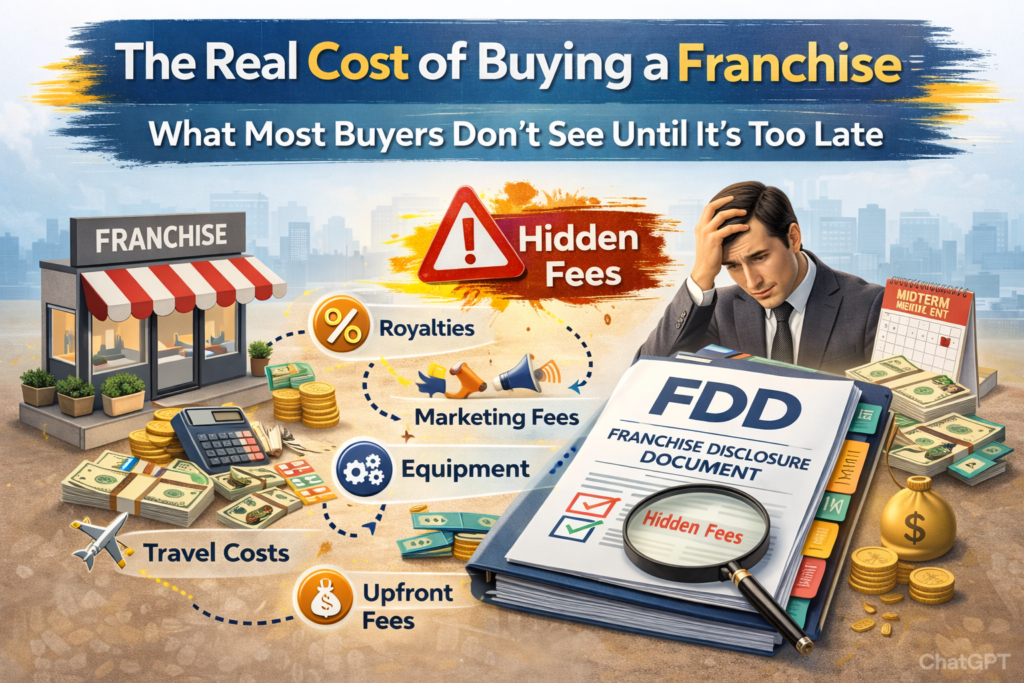
The Real Cost of Buying a Franchise: What Most Buyers Don't See Until It's Too Late
The Real Cost of Buying a Franchise: What Most Buyers Don't See Until It's Too Late
“What does a franchise cost?” Most people hear the franchise fee and stop there. That number is just the entry ticket—not the total investment.
If you’ve ever searched “how much does a franchise cost” and walked away with a figure that felt manageable, you may be looking at an incomplete picture. The real cost of buying a franchise is significantly larger than the headline fee suggests, and understanding every layer of that investment is the difference between walking into ownership with confidence and running out of runway by month four.
This guide breaks down every major cost component in plain language—franchise fees, buildout, equipment, working capital, and contingency reserves—so you know exactly what you’re funding before you sign anything.
Cost Component #1: The Franchise Fee
The franchise fee is a one-time, upfront payment made to the franchisor in exchange for the right to operate under their brand, system, and support infrastructure. It is not a refundable deposit. It is not a partial investment—it is a fee paid in exchange for access.
Franchise fees across the industry typically range from $20,000 to $50,000 for single-unit agreements, though premium brands can charge $50,000 to $100,000 or more. Multi-unit or area development agreements often include a reduced per-unit fee in exchange for committing to multiple openings.
What does the franchise fee actually cover? Generally: initial training, protected territory rights, brand licensing, access to the franchisor’s operating systems, proprietary technology, and pre-opening support. What it does not cover: your physical location, your equipment, your staff, or your first few months of operating expenses.
Think of the franchise fee as tuition. You pay it once to gain access to the school—but you still need to furnish your dorm, buy your books, and cover living expenses.
Cost Component #2: Buildout and Leasehold Improvements
For any franchise that requires a physical location—retail, food service, fitness, health, beauty, childcare, and many service businesses—the buildout cost is typically the single largest line item in the real cost of buying a franchise.
Buildout refers to the construction, renovation, and build-to-spec work required to transform a raw or existing commercial space into a franchise-approved location. Depending on whether you’re taking a vanilla shell (empty, unfinished space), a second-generation location (previously occupied), or building from the ground up, costs vary dramatically.
Industry-wide buildout ranges:
- Low-investment service franchise (mobile or home-based): $0–$15,000
- Retail or boutique concept: $75,000–$250,000
- Quick-service restaurant (QSR): $200,000–$600,000
- Full-service restaurant or specialty food: $400,000–$1,000,000+
- Fitness, medical, or healthcare concept: $150,000–$500,000
These figures can shift significantly based on local construction costs, contractor availability, permitting timelines, and franchisor design specifications. It is not uncommon for a buildout to run 10–25% over initial estimates due to permit delays, material costs, or required design changes. This is a critical reason why contingency reserves matter—covered in the final section.
Leasehold improvements—the portion of the buildout funded by the tenant—may be partially offset by a tenant improvement (TI) allowance from your landlord. TI allowances vary widely by market and landlord negotiating position. In competitive markets, TI allowances may cover a meaningful portion of costs; in others, they may be minimal or nonexistent.
Cost Component #3: Equipment, Fixtures, and Technology
Equipment and fixtures are separate from the buildout itself and represent another substantial category within the real cost of buying a franchise. This includes everything from cooking equipment and refrigeration units (for food concepts) to point-of-sale systems, branded furniture, signage, vehicles, and proprietary technology platforms.
Most franchisors have approved vendor lists and proprietary technology requirements. You are generally not free to purchase equivalent alternatives independently—you must buy approved brands and systems. This matters because franchisor-approved vendors may not always offer the most competitive pricing in your region.
Estimated equipment and technology costs by concept type:
- Service franchise (cleaning, landscaping, staffing): $5,000–$50,000
- Retail franchise: $30,000–$100,000
- Food and beverage: $80,000–$300,000+
- Fitness or wellness: $50,000–$200,000
Technology fees often include POS hardware, proprietary software licensing, security systems, and integration with the franchisor’s central reporting infrastructure. These may be purchased outright or leased—always confirm which model applies for the franchise you are evaluating.
Cost Component #4: Working Capital
Working capital is the operating cash reserve that funds your business from the day you open until the day your revenue covers your expenses. It is the most chronically underestimated component of the real cost of buying a franchise.
Every business—including franchises with the strongest brand recognition—goes through a ramp-up period. You will likely open with lower-than-projected revenue. Your team will be learning. Your marketing campaigns will be in their early stages. Your local customer base is still discovering you. This is not a failure scenario—it is a normal business reality. The difference between businesses that survive it and those that don’t is whether they had enough working capital to fund the gap.
A standard working capital recommendation is three to six months of total operating expenses. Total operating expenses typically include: rent, labor, royalties, marketing fund contributions, utilities, insurance, supplies, and owner living expenses if the franchise is your primary income.
Running out of working capital is the #1 reason franchise owners fail in their first year—not poor systems, not bad branding. The funding gap.
Cost Component #5: Grand Opening and Pre-Launch Marketing
Launching a franchise is not passive. The franchisor’s national marketing fund does not replace your local market activation—it supports it. Most FDDs require franchisees to spend a defined amount on grand opening marketing, typically ranging from $5,000 to $30,000 depending on the concept.
This budget should fund local digital campaigns, social media presence, direct mail, grand opening events, and any promotional offers designed to drive initial trial. In markets where the brand has low existing awareness, this investment is especially critical. Many buyers treat the grand opening as a cost to minimize—this is the wrong instinct. The first 90 days of traffic patterns often determine your long-term customer base.
Marketing costs to budget for beyond the franchise fee and buildout:
- Grand opening marketing spend: $5,000–$30,000
- Ongoing local marketing obligations (per FDD): typically 1–3% of gross revenue
- National marketing fund contributions: typically 1–4% of gross revenue
- Pre-opening digital setup (website, local SEO, Google Business Profile): $1,000–$5,000
Cost Component #6: Professional Fees, Permits, and Pre-Opening Costs
Before you open your doors, there is a category of costs that accumulate quietly and are often overlooked until invoices arrive. These include legal fees (attorney review of the FDD and franchise agreement is strongly recommended), business formation costs, state and local licensing and permits, food handler certifications if applicable, insurance deposits, and utility deposits.
Professional and pre-opening cost estimates:
- Franchise attorney review of FDD and agreement: $2,000–$5,000
- Business entity formation (LLC/S-Corp): $500–$1,500
- Permits and licenses: $500–$5,000 depending on concept and municipality
- Insurance setup (general liability, workers’ comp, commercial property): $3,000–$10,000/year
- Training travel and lodging: $1,000–$5,000
These fees don’t generate revenue—they are the cost of operating legally and protected. Skipping the franchise attorney in particular is a false economy. The franchise agreement is a long-term, asymmetric contract. Understanding it fully before signing is not optional.
Cost Component #7: Contingency Reserves — The Most Overlooked Line Item
No buildout comes in perfectly on budget. No grand opening hits revenue projections in week one. No lease negotiation goes exactly as planned. Contingency reserves exist specifically for the reality that the real cost of buying a franchise will include surprises—and surprises cost money.
A standard contingency reserve is 10–20% of your total projected startup cost. If your projected all-in investment is $300,000, you should hold $30,000–$60,000 in accessible reserve. This is not working capital—it is insurance against cost overruns, delays, and unexpected obligations.
Common scenarios where contingency reserves are consumed:
- Buildout runs over due to contractor delays or material cost increases
- Permitting or inspections take longer than expected, delaying your opening date
- Equipment arrives damaged or requires replacement
- Additional training required beyond what was budgeted
- Lease terms require a larger security deposit than expected
- Revenue ramp-up is slower than Item 19 projections suggested
Buyers who launch without contingency reserves are one unexpected expense away from a cash crisis. This is a category that Franchise Solutions 360 specifically addresses in capital planning—because it is where the difference between success and distress is often determined.
Putting It All Together: A Real-World Investment Summary
Cost Category | Typical Range | Notes |
Franchise Fee | $20,000 – $100,000 | One-time; non-refundable; brand access |
Buildout & Leasehold Improvements | $0 – $1,000,000+ | Varies dramatically by concept type |
Equipment & Technology | $5,000 – $300,000 | Per approved vendor requirements |
Working Capital (3–6 months) | $30,000 – $150,000 | Most underestimated; plan for the high end |
Grand Opening Marketing | $5,000 – $30,000 | Required by most FDDs; invest here |
Professional & Pre-Opening Fees | $5,000 – $25,000 | Legal, permits, insurance, training |
Contingency Reserve (10–20%) | 10–20% of total | Non-negotiable buffer for overruns |
For a mid-tier food or retail franchise concept, a realistic total investment including all of the above commonly falls between $250,000 and $500,000. For premium or high-volume brands, $750,000 to $1.5 million is not uncommon. For home-based or mobile service franchises, total investment can be as low as $50,000 to $100,000 all-in.
How to Fund the Real Cost of Buying a Franchise
Understanding total investment is step one. Structuring a funding plan that doesn’t leave you undercapitalized is step two. Common franchise financing approaches include SBA 7(a) loans (one of the most widely used vehicles for franchise funding), ROBS (Rollover for Business Startups, allowing retirement funds to be deployed without early withdrawal penalties), franchisor financing programs, and conventional business loans.
The SBA has a Franchise Registry that identifies FDD-approved concepts eligible for expedited SBA loan processing. Not all franchises qualify, and lender requirements—credit score, liquidity, industry experience—vary. Working with a consultant who understands the full capital stack, not just the loan application, is critical to building a funding plan that leaves enough reserve capital after closing.
The right franchise with underfunding is just as risky as the wrong franchise. Capital planning is not a detail—it is a foundation.
What to Do Before You Calculate Your Budget
Before you calculate what you can afford, you need a clear picture of your total liquid capital, your ability to qualify for financing, your household income requirements during ramp-up, and your risk tolerance. These inputs determine not just what you can buy, but what you should buy.
An education-first approach to franchise evaluation means you understand the full cost picture before you review a single FDD. At Franchise Solutions 360, we help aspiring franchisees model total investment requirements, identify financing pathways, and build a capital plan designed for long-term sustainability—not just entry.
Frequently Asked Questions About the Real Cost of Buying a Franchise
The total cost of buying a franchise includes the initial franchise fee, buildout and leasehold improvements, equipment and technology, working capital reserves (typically 3–6 months of operating expenses), grand opening marketing, professional fees (legal, accounting, permits), and a contingency reserve of 10–20% of the projected total. The franchise fee is usually the smallest line item in the full investment.
Most franchise consultants and lenders recommend budgeting at least three to six months of total operating expenses as working capital. This covers rent, labor, royalties, supplies, and owner living expenses during the ramp-up period before your revenue stabilizes. For competitive or high-cost markets, planning for the upper end of this range—or beyond—is strongly advised.
A franchise fee is a one-time upfront payment to the franchisor in exchange for the rights to operate under their brand, system, and support structure. In virtually all cases, the franchise fee is non-refundable once paid. It covers initial training, territory rights, and access to the franchisor's operating systems—it does not fund your physical location or operating expenses.
A buildout cost refers to the construction, renovation, and design work required to transform a commercial space into a franchise-approved location. This includes demolition, framing, flooring, millwork, signage, HVAC modifications, plumbing, electrical, and decor—all meeting the franchisor's brand standards. Buildout is often the largest single expense in the real cost of buying a franchise.
A contingency reserve is a cash buffer held outside of your working capital to absorb cost overruns, permit delays, equipment issues, or slower-than-expected revenue in your opening months. Most financial planners and franchise consultants recommend setting aside 10–20% of your total projected startup cost as a contingency. Without it, a single unexpected expense can create a cash crisis before your business reaches break-even.
The Franchise Disclosure Document (FDD) is required by the FTC for all U.S. franchisors and includes estimated startup costs in Item 7. Item 7 provides a range for each cost category, including the franchise fee, buildout, equipment, working capital, and other initial expenses. Buyers should treat Item 7 ranges as a floor—real-world costs frequently come in at the higher end or above, depending on your market and contractor costs.
Common franchise financing options include SBA 7(a) loans, ROBS (Rollover for Business Startups using retirement savings), conventional business loans, franchisor financing programs, and home equity lines of credit. The right structure depends on your liquidity, credit profile, timeline, and the specific franchise's SBA registry status. Working with a franchise consultant who understands capital planning—not just the loan application—helps ensure you're funded at a level that supports long-term sustainability, not just the opening day.
The average total investment to buy a franchise varies widely by concept. Home-based and mobile service franchises may require $50,000–$100,000 all-in. Retail and fitness concepts often fall in the $150,000–$400,000 range. Quick-service restaurants (QSRs) typically range from $300,000 to $800,000. Premium food or full-service brands can exceed $1 million. These figures include all cost components—not just the franchise fee.
Ready to Understand the Real Cost of Buying a Franchise — Before You Commit?
At Franchise Solutions 360, we believe no one should make a six-figure decision without a complete picture. Our education-first approach means we walk you through every cost component, help you build a realistic capital plan, identify the right financing pathway for your situation, and evaluate franchise opportunities based on fit—not pressure.
We work with aspiring franchisees, multi-unit operators, and investors across the country. Whether you’re at the research stage or ready to review your first FDD, a single conversation can clarify what you’re actually looking at—and what it takes to make it work.
Not Sure Which Path Is Right for You?
Franchise Solutions 360 offers an education-first franchise consulting process — no pressure, no sales pitch. We help you evaluate both paths honestly, understand true costs, and build a decision framework based on your goals, capital, and risk profile.
Latest Posts
What Franchise Break-Even Timeline Really Reveals About ROI
5 Questions to Ask During Franchise Validation Calls
The Real Cost of Buying a Franchise: What Most Buyers Don’t See Until It’s Too Late
Franchise vs. Starting a Business: Which Path Is Right for You?
How to Read a Franchise Disclosure Document (FDD): Complete Beginner’s Guide 2026