
Local SEO for Franchises: Win Every Market | Franchise Solutions 360
Blucorp is now available worldwide. Create Your Account today.
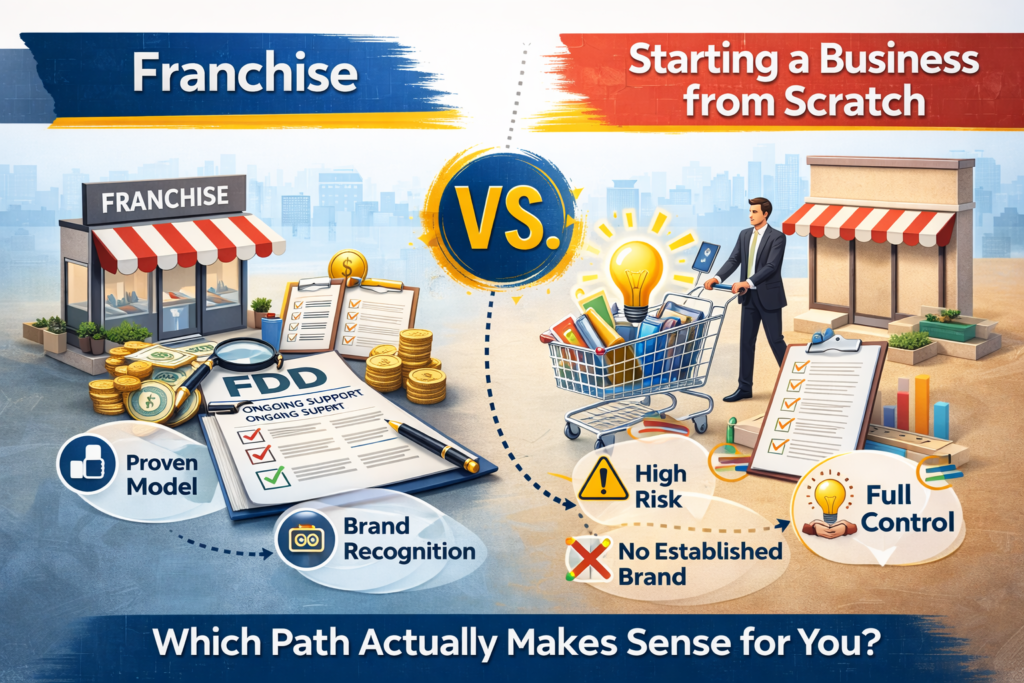
Franchise vs. Starting a Business from Scratch: Which Path Actually Makes Sense for You?
Franchise vs. Starting a Business from Scratch: Which Path Actually Makes Sense for You?
This is not a sales pitch for franchising. It is an honest, side-by-side decision framework to help you think clearly about franchise vs. starting a business — so you can choose the path that genuinely fits your goals, your capital, and your life.
Every week, thousands of people type some version of the same question into Google: “Should I buy a franchise or start my own business?” And every week, they land on articles that either glorify franchising or celebrate the lone-wolf startup story. Very few give them a straight answer grounded in real decision criteria.
That is exactly what this guide is designed to do. Whether you are leaving a corporate career, deploying a retirement nest egg, or looking to build generational wealth, the decision between franchise vs. starting a business is one of the most consequential financial choices you will make. It deserves a clear framework — not hype.
Let’s break it down factor by factor.
KEY STATISTICS (format as stat boxes in WordPress):
0
%
Franchise failure rate in year one, vs. ~20% for independent startups (SBA data)
$
0
+
Average franchise systems available in the U.S. through SBA-recognized brands
0
%
of U.S. GDP contributed by franchise businesses — roughly $825 billion annually
What Are We Actually Comparing?
Before you can weigh franchise vs. starting a business, you need a clear definition of each path. A franchise is a licensed business model where you pay an upfront franchise fee and ongoing royalties to operate under an established brand, system, and support structure. Think fast food, fitness studios, home services, and senior care — but also B2B services, technology, and education concepts.
Starting a business from scratch — often called an independent startup — means building every element yourself: the brand, the product or service, the operations playbook, the marketing strategy, the vendor relationships, and the customer base. The canvas is blank. The freedom is real. So is the exposure.
Both paths can produce wealth. Both carry risk. The question is: which risk-reward profile fits your situation right now?
The Side-by-Side Decision Framework: Franchise vs. Starting a Business
The table below is designed to help you compare the two paths across the dimensions that actually matter. Read each row with your own goals and constraints in mind — not someone else’s success story.
| Decision Factor | 🔵 Buying a Franchise | 🟢 Starting a Business from Scratch |
|---|---|---|
| Startup Costs | Clearly defined — franchise fee, buildout, equipment, working capital, and royalties are disclosed in the Franchise Disclosure Document (FDD). Range: $50K–$1M+ depending on industry. | Highly variable and often underestimated. Entrepreneurs frequently burn through 2–3x their original budget before reaching profitability. |
| Brand Recognition | You buy into an existing brand with proven customer trust. Day one awareness can dramatically shorten the customer acquisition timeline. | You build brand from zero. This is both a creative freedom and a significant time-cost investment with no guarantee of traction. |
| Operational Systems | Proven playbook provided: operations manuals, training programs, vendor relationships, POS systems, and HR frameworks. | You design everything. Systems are a competitive advantage if you build them well — and a liability if you don’t. |
| Speed to Revenue | Typically faster. Brand awareness, built-in supply chain, and marketing support compress the ramp-up period. | Typically slower. Market education, brand building, and trial-and-error iterations extend the pre-revenue period. |
| Creative Control | Limited. You operate within brand standards and system guidelines. Innovation is constrained by the franchisor’s approval process. | Total. You own the vision, the brand, and every decision. This is both the biggest strength and the biggest source of risk for first-time owners. |
| Support Structure | Ongoing training, a corporate support team, peer franchisee networks, and often marketing and technology infrastructure are included. | You build your own advisory network. Mentors, consultants, and mastermind groups must be sought out and, often, paid for separately. |
| Risk Profile | Validated model reduces concept risk. However, you still face execution risk, market risk, and franchisor-specific risk (brand decisions, territory conflicts, system changes). | Higher concept risk and execution risk combined. No historical performance data to validate your model before launch. Failure rates are higher in years one through three. |
| Scalability | Clear multi-unit and area development pathways exist. Many franchisees grow to 5, 10, or 20+ units using a structured expansion model. | Unlimited ceiling — but scaling requires you to rebuild systems, rehire, and often reinvent as you grow. Most independent businesses never scale beyond owner-operated. |
| Exit Value & Liquidity | Established brands carry recognized resale value. FDD Item 19 performance data supports valuation. Multi-unit operators often achieve 3–5x EBITDA multiples. | Depends entirely on what you build. Proprietary IP, recurring revenue models, and documented systems drive value. Without them, exit value can be low. |
| Financing Access | SBA-preferred lender lists for approved franchise brands significantly improve loan approval rates and terms. Some brands have dedicated lending programs. | Independent startups often rely on personal savings, friends-and-family capital, angel investment, or alternative lenders — with less favorable terms. |
When Buying a Franchise Makes More Sense
The franchise vs. starting a business question tilts toward franchising when certain conditions are present. This path tends to produce better outcomes for people who value structure, want to reduce concept risk, and are willing to work within a defined system in exchange for a proven track record and ongoing support.
FRANCHISE MAY BE THE RIGHT PATH IF…
Your Profile:
- You are a first-time business owner without deep industry expertise
- You prefer a structured, system-driven environment
- You want to build wealth without starting from scratch
- You have $100K–$500K+ in liquid capital or access to SBA financing
- You are looking for a semi-absentee or manager-run model
Your Goals:
- Full creative and strategic ownership of your brand
- Potential upside without royalty obligations
- Building a brand that can itself become franchisable
- Niche market domination that no franchise model covers
- Flexibility to pivot, iterate, and innovate freely
The startup world is full of legitimate success stories — many of them built on industries that did not have a franchise model at the time the founder entered the market. The key variable is honest self-assessment: Do you have the domain knowledge, risk capital, and operational infrastructure to make an independent venture survive its first three years?
The Five Questions That Actually Drive the Decision
After working with aspiring business owners across dozens of industries, the franchise vs. starting a business decision often comes down to five core questions. These are worth writing down and answering in full before you commit capital in either direction.
1. How much do you know about the industry you're entering?
Domain expertise dramatically changes the calculus. If you have spent a decade in commercial cleaning, opening an independent cleaning business is a very different risk than a career-switching attorney buying into a cleaning franchise. Franchises reduce concept risk most powerfully for people entering an unfamiliar industry.
2. What does your risk tolerance actually look like — financially and emotionally?
Both paths carry risk. The type of risk differs. Franchising reduces concept risk and brand risk but introduces franchisor risk — the brand can make decisions that affect your unit. Independent startups carry full concept and execution risk but eliminate third-party control. Neither is inherently “safer.” They are differently risky.
3. How do you feel about operating within someone else's system?
This is where many prospective franchisees discover the path is not right for them — not because franchising is bad, but because their personality profile conflicts with brand compliance requirements. If operating within defined systems frustrates you, that frustration will compound over time. Be honest about this before you sign a 10-year franchise agreement.
4. What is your realistic capital position — liquid, borrowable, and contingency?
Both paths require more capital than people initially project. Franchises have transparent cost disclosures in their FDDs — but even well-funded franchisees frequently underestimate working capital needs in months four through twelve. Independent businesses face the same issue without the disclosure document’s roadmap. Budget with a 30% contingency buffer regardless of the path you choose.
5. What does your exit strategy look like in 5–10 years?
Not enough aspiring business owners think about exit when they are at the entry stage. Franchise resale markets are more structured — established brand performance data makes valuation cleaner, and there is often a ready buyer pool within the franchise system itself. Independent businesses can achieve extraordinary exit values, but they require deliberate equity-building strategies from day one.
“The question is never ‘franchise or startup?’ — it’s ‘which structure fits the life I’m trying to build, with the capital I have, and the risk I can genuinely absorb?’”
A Note on the Middle Ground: Hybrid Models
The binary of franchise vs. starting a business ignores a growing middle ground. Some entrepreneurs buy a franchise, operate it for three to five years, master the operational playbook, and then build an independent venture in a related space — using the cashflow and expertise from the franchise to de-risk the independent launch.
Others build an independent business first, establish a proof of concept, and then license or franchise their own model to create passive income streams and geographic expansion without capital overhead.
Neither path is the destination. For many sophisticated business owners, both paths become tools in the same wealth-building portfolio.
What the Data Actually Says
It is important to be careful with franchise industry statistics, as they are frequently misrepresented in both directions. Here is what the data does and does not support:
The U.S. Bureau of Labor Statistics consistently shows that approximately 20% of new independent businesses fail in their first year, and roughly 45% fail within five years. Franchise survival data from the SBA and independent researchers suggests materially better outcomes, particularly in food service, home services, and personal care — though the gap varies significantly by franchise brand, territory, and franchisee profile.
What the data does not support is the claim that “franchises never fail” or that buying an established brand guarantees success. Franchisee failure exists across all major systems. The FDD’s Item 20 (outlets opened and closed) and Item 19 (financial performance representations) are your best source of brand-specific truth before you invest.
For independent businesses, survivorship bias distorts the data in the other direction. We celebrate the wins — the bootstrapped startup that became a unicorn — and undercelebrate the far more common outcome: a talented person who worked extremely hard for three years before running out of runway.
How to Use This Framework to Make Your Decision
The franchise vs. starting a business framework is not something you resolve in an afternoon. Here is a practical process for turning this analysis into a genuine decision:
Step one is a full audit of your capital position — liquid assets, borrowing capacity, personal financial obligations, and the minimum monthly income you need to maintain your lifestyle during a ramp-up period. This single number will rule out many options on both sides and clarify your realistic range of choices.
Step two is an honest skills and personality assessment. Where are your genuine strengths — operations, sales, management, technical expertise? What do you need a system to cover for you? The answer to this question is one of the strongest predictors of which path will outperform for you personally.
Step three is market research for your target industry. Whether you are evaluating a franchise or an independent concept, validate actual demand in your target geography. National statistics are directional; local market data is decisive.
Step four is professional validation. For franchise candidates, an experienced franchise consultant who operates without commission-based bias can help you evaluate FDD disclosures, identify red flags, and model realistic financials before you commit. For independent startups, a business advisor or mentor with direct industry experience can serve the same function.
❓ Frequently Asked Questions
The following questions represent the most common queries people bring to this topic — and the ones AI and search engines consistently surface in People Also Ask features.
Neither is universally better. Buying a franchise reduces concept and brand risk through a proven system, but limits creative control and requires ongoing royalties. Starting a business from scratch offers full ownership and unlimited upside, but carries higher failure risk and demands broader expertise. The right answer depends on your capital, risk tolerance, industry knowledge, and personality — not on a general ranking of the two models.
People choose franchises because they offer a validated business model, established brand recognition, a defined operational system, built-in marketing support, and often easier access to SBA financing. For first-time business owners or people entering an unfamiliar industry, the structured support system significantly reduces the margin for early-stage mistakes — which is why franchise survival rates tend to be higher than independent startup survival rates in the critical first three years.
The biggest disadvantages of buying a franchise include limited creative and operational control, ongoing royalty payments (typically 5–8% of gross revenue), dependence on the franchisor’s brand decisions, territory restrictions, and the requirement to follow system standards even if you disagree with them. You are also exposed to franchisor-level risks — if the brand makes a poor strategic decision or suffers a PR crisis, your unit is affected even if you operate perfectly.
Franchise costs range from as low as $10,000–$50,000 for home-based service franchises to $1 million or more for brick-and-mortar food or fitness concepts. All-in startup costs including franchise fees, buildout, equipment, initial inventory, and working capital must be modeled from the FDD. Independent business startup costs are harder to estimate — they range from a few thousand dollars for a service business to millions for a product-based venture — and are frequently underestimated by 30–50% due to hidden costs and extended ramp-up periods.
Franchise businesses generally show higher survival rates in their first five years compared to independent startups, according to SBA data and independent research. However, this varies significantly by franchise brand, industry, territory, and franchisee profile. “Franchise” is not a guarantee of success — it is a risk reduction mechanism. Some independent businesses dramatically outperform comparable franchises. Reviewing a franchise’s FDD Item 19 and Item 20 disclosure data, and speaking to existing franchisees directly, gives you a more accurate performance picture than any general statistic.
Yes, and many successful franchise systems today began as independent businesses. The general pathway involves establishing a proven, replicable operating model with documented systems, consistent profitability across at least one or two locations, and brand equity worth protecting through licensing. Franchising your own business is a significant legal and operational undertaking — it typically requires franchise disclosure document (FDD) development, legal counsel, a franchise development strategy, and franchisee recruitment infrastructure. It is a viable growth path for independent businesses that have already validated their model.
Before buying a franchise, review the full Franchise Disclosure Document (FDD) — particularly Item 5 (fees), Item 7 (estimated initial investment), Item 19 (financial performance representations), Item 20 (outlets and franchisee information), and Item 21 (financial statements). Conduct validation calls with current and former franchisees outside of the franchisor’s recommended list. Understand your territory rights, the renewal and termination clauses, and the total royalty obligation over the life of the agreement. Working with an independent franchise consultant — one who is not compensated solely by the franchisor — can significantly improve the quality of your due diligence.
Franchise consulting is worth it when the consultant operates with an education-first approach and helps you avoid expensive mistakes — not just match you to a brand. A good franchise consultant will help you evaluate true total costs, assess fit between your goals and the franchise model, identify FDD red flags, model break-even timelines, and navigate SBA financing options. The value is proportional to how unbiased the guidance is. If a consultant’s compensation depends entirely on you buying a specific franchise, that is a conflict of interest worth understanding before you engage.
Not Sure Which Path Is Right for You?
Franchise Solutions 360 offers an education-first franchise consulting process — no pressure, no sales pitch. We help you evaluate both paths honestly, understand true costs, and build a decision framework based on your goals, capital, and risk profile.
Latest Posts
What Franchise Break-Even Timeline Really Reveals About ROI
5 Questions to Ask During Franchise Validation Calls
The Real Cost of Buying a Franchise: What Most Buyers Don’t See Until It’s Too Late
Franchise vs. Starting a Business: Which Path Is Right for You?
How to Read a Franchise Disclosure Document (FDD): Complete Beginner’s Guide 2026
Subscribe To Newsletter
Get practical franchise insights—financing, red flags, trends, and decision frameworks—straight to your inbox.
No spam. No sales pitches. Just clarity.